Common Garden Diseases and How to Treat Them
By Growing Home Greens Team · August 7, 2026
Garden diseases usually show themselves as a pattern before you can name the cause: a coating that wipes off, a ring that climbs, a patch that turns black overnight. The pattern narrows down what’s wrong faster than a guess ever will, and it tells you whether the plant can be saved or should come out before it spreads.
A white, powdery coating that wipes off
Powdery mildew shows up as a flour-like dusting on the top of leaves, most often on zucchini, winter squash, and cucumber. Unlike most fungal disease, it doesn’t need wet leaves to spread; it favors dry air with high humidity, warm days and cool nights being the classic setup. It rarely kills a plant outright, but it does cut yield by shading out photosynthesis. Remove the worst-affected leaves, improve airflow by thinning crowded plants, and a weekly spray of diluted milk or potassium bicarbonate slows new growth on what’s left. A fungicide is rarely worth reaching for until the infection is already established.
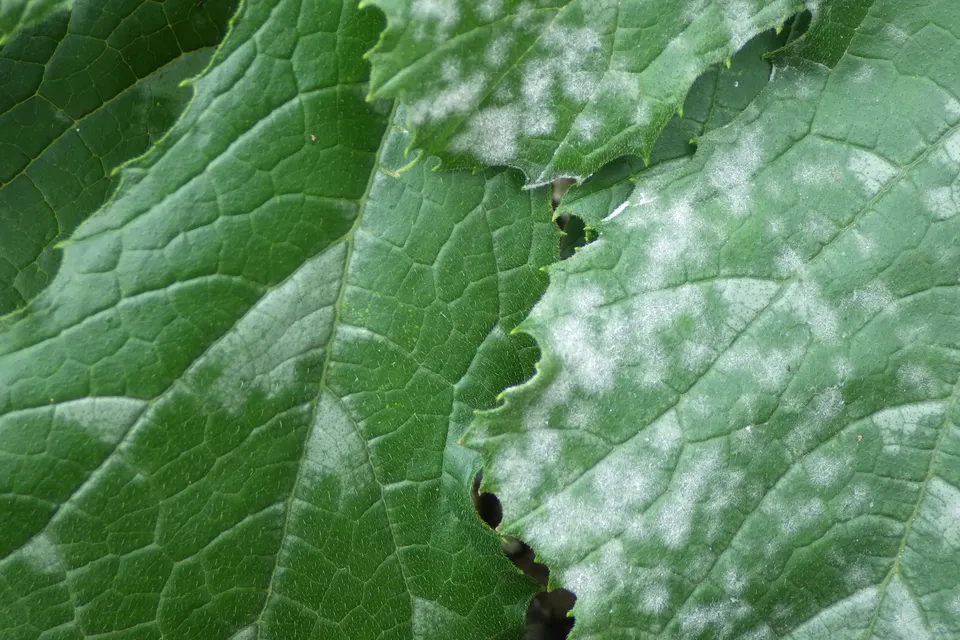 Photo: Schlaghecken Josef via Wikimedia Commons, CC BY-SA 4.0, cropped.
Concentric brown rings that climb from the bottom up
Early blight starts on the oldest, lowest leaves of tomato and potato plants as small brown spots with visible concentric rings, almost like a target. Left alone, it climbs the plant leaf by leaf, defoliating from the bottom as it goes. It thrives where water splashes soil up onto foliage, so a layer of mulch under the plant does more preventive work than any spray. Once it’s present, remove infected leaves as soon as you see them and avoid overhead watering, which spreads spores onto healthy foliage.
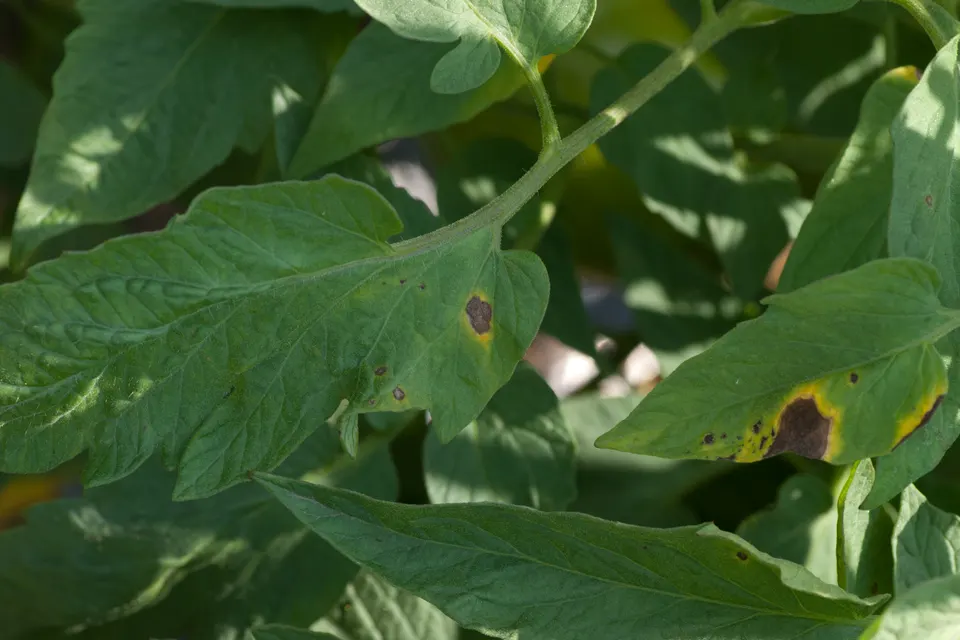 Photo: Dwight Sipler from Stow, MA, USA via Wikimedia Commons, CC BY 2.0, cropped.
Water-soaked patches that turn black almost overnight
Late blight moves faster and does far more damage. Dark, greasy-looking patches appear on leaves, stems, and fruit alike, and in humid weather a pale fuzzy growth shows on the undersides of leaves. It can collapse a healthy plant within days, which is what made it the disease behind the Irish potato famine. There’s no effective cure once it’s established. Pull and destroy infected plants immediately, don’t compost them, and don’t plant tomatoes or potatoes in that bed again the following year without a multi-year gap.
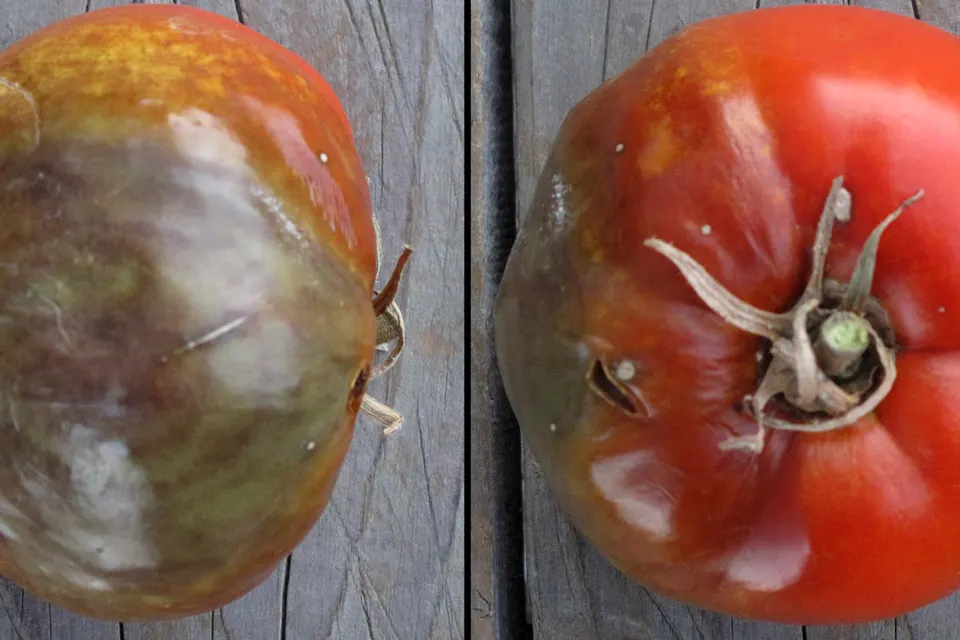 Photo: Downtowngal via Wikimedia Commons, CC BY-SA 3.0, cropped.
Yellow blotches on top, fuzzy growth underneath
Downy mildew is often confused with powdery mildew but needs the opposite conditions: extended leaf wetness and cool, humid nights. It shows as yellow, angular patches on the top of a leaf, bounded by the leaf veins, with grayish-purple fuzz visible on the underside if you flip the leaf over. Basil and cucurbits are the most common hosts. Space plants for airflow, water at the soil line rather than overhead, and remove infected leaves promptly, since spores spread easily on wind and splashing water.
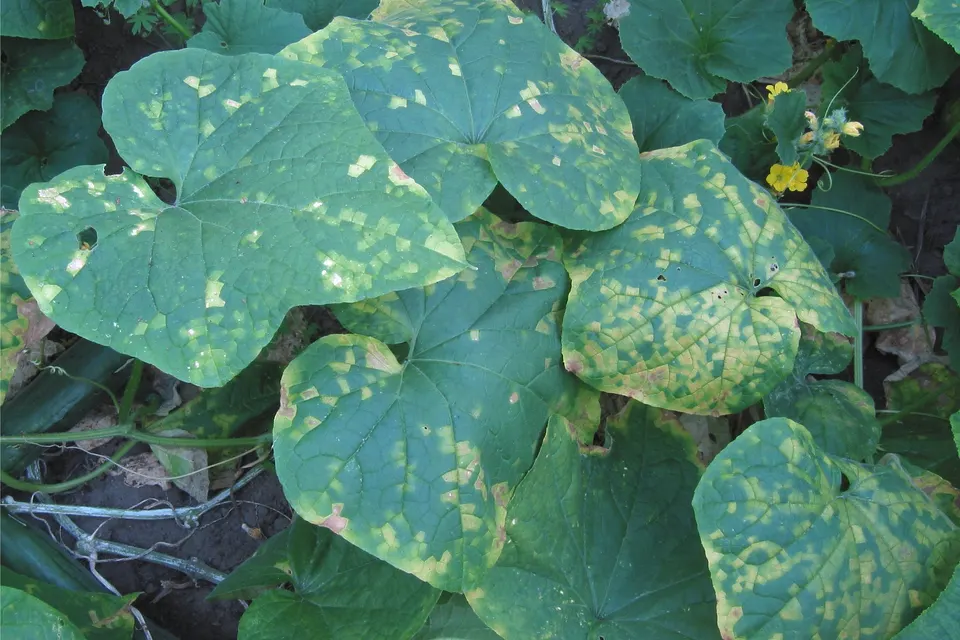 Photo: Rasbak via Wikimedia Commons, CC BY-SA 3.0, cropped.
A sunken black patch on the fruit, not the leaves
Blossom end rot looks like a disease but isn’t one. It’s a calcium delivery problem, not a calcium shortage in the soil, caused by inconsistent watering that interrupts the plant’s ability to move calcium into the fruit. It shows up as a flat, leathery, dark patch at the blossom end of tomatoes, peppers, and squash, usually while the rest of the fruit looks fine. Adding calcium to the soil almost never fixes it. Even, consistent watering does, along with a layer of mulch to buffer the soil against dry spells.
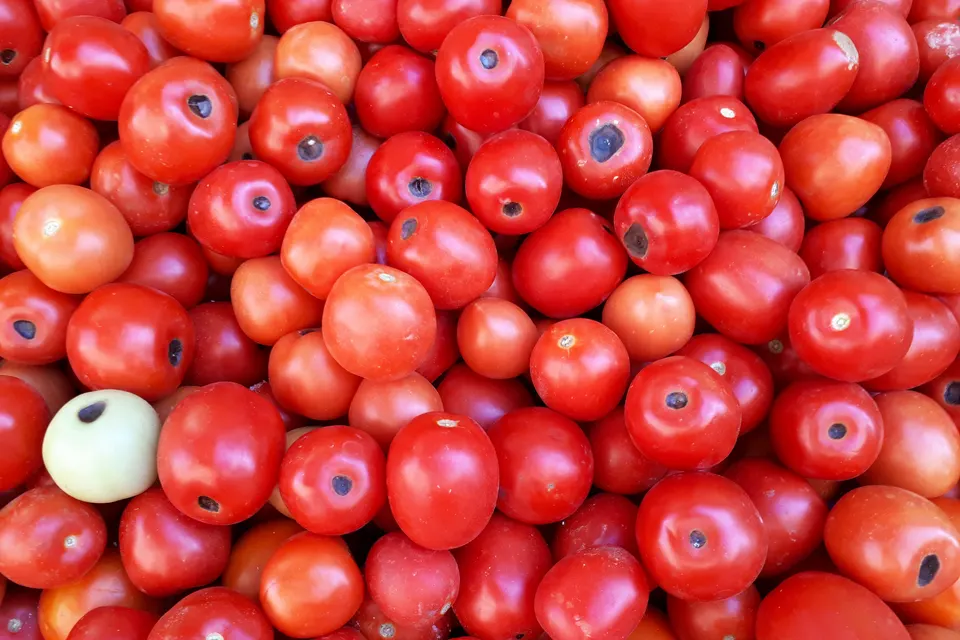 Photo: Fructibus via Wikimedia Commons, CC0, cropped.
Fixing the pests once you’ve identified them
The pest identification guide covers what’s chewing or sucking on a plant; the fix usually depends on the pest more than the plant. Aphids and whiteflies come off with a strong jet of water from the hose, repeated every few days until the population drops. Hand-picking is still the most reliable control for tomato hornworms and cabbage worms, since there usually aren’t many at once. For repeat chewing pests like flea beetles and cabbage moths, a floating row cover over young plants keeps them from ever landing, which beats treating the damage after the fact.
As an Amazon Associate we earn from qualifying purchases. Some links on this page also go to other retailers we may earn a commission from as an affiliate, at no extra cost to you. We only recommend products with a clear consensus of positive, independent reviews, or ones we bought and use ourselves. Each item on our gear page says which.

Pin this for later
Common Garden Diseases and How to Treat Them: Where a spot starts, what color it turns and how fast it spreads will usually tell you which disease you have, and what to do next.
Save to Pinterest