Growing Onions: A Complete Profile
By Growing Home Greens Team · July 18, 2026
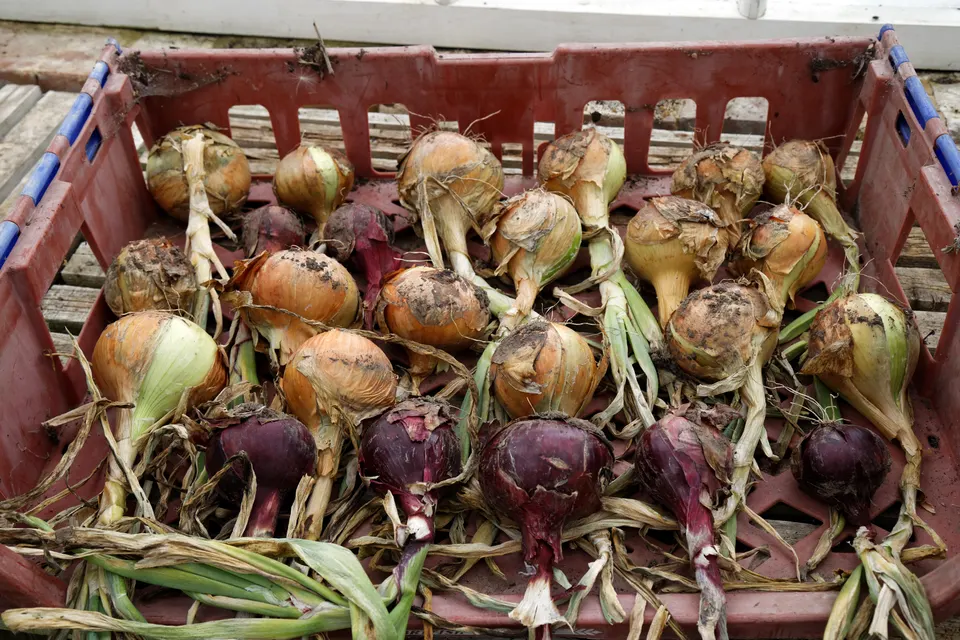
Onions are one of the slower crops in the garden, around 100 days from transplant to harvest, and they start life indoors well before most of the garden is even being planned, which catches a lot of first-time growers off guard. There’s no shortcut here: get the timing right up front and the rest of the crop mostly takes care of itself.
Starting it indoors, months before the ground is ready
Start onions indoors about 8 weeks before your last frost date and set transplants out roughly 3 weeks before that date arrives. They tolerate a light frost fine. Onions are also one of the few crops planted dense: 9 per square foot, packed in tight, since each plant only needs room for a single bulb rather than sprawling foliage. Which variety bulbs up properly in your area depends heavily on day length (short-day, day-neutral, or long-day types are matched to latitude), so check what’s sold locally rather than assuming a variety that worked for a neighbor two states away will perform the same for you.
Thin bulbs mean the wrong day-length type
Thin, scallion-like bulbs at harvest are usually a day-length mismatch, the wrong type of onion for your latitude never gets the trigger to bulb up properly, no matter how well it’s otherwise grown. Bulbs that rot in storage often started with damage at harvest; let the tops fully flop over and the necks dry out before pulling and curing.
A dense edge crop that helps its neighbors
Onion’s sulfur scent is reputed to confuse pests looking for carrots and brassicas by smell, which is why it shows up as a companion across several other profiles. See the full companion guide for onions. Its dense 9-per-square-foot spacing makes it a good edge or border crop in the Garden Designer, and because it occupies a bed for the better part of a season, plan around what else needs that square footage before and after it.
Companion planting guide for Onion · Find your planting dates
Typically viable in USDA zones 3-10. Not sure your zone? Look it up by ZIP code.
Mature height: 1-1.5 ft
Method: Start indoors: Start indoors from seed, then transplant outside. It needs a head start most zones can't give it by direct-sowing alone.
When to plant onion, by zone
Every zone onion grows in. Pick your zone in the header and it will be highlighted here. Each zone links to its full page.
| Zone | Start indoors | Sow or plant out | Harvest |
|---|---|---|---|
| 3a & 3b | Apr 4–Apr 11 | May 9–May 16 | Aug 17–Aug 24 |
| 4a & 4b | Mar 20–Mar 27 | Apr 24–May 1 | Aug 2–Aug 9 |
| 5a & 5b | Mar 15–Mar 22 | Apr 19–Apr 26 | Jul 28–Aug 4 |
| 6a & 6b | Feb 28–Mar 7 | Apr 4–Apr 11 | Jul 13–Jul 20 |
| 7a & 7b | Feb 13–Feb 20 | Mar 20–Mar 27 | Jun 28–Jul 5 |
| 8a & 8b | Jan 28–Feb 4 | Mar 4–Mar 11 | Jun 12–Jun 19 |
| 9a & 9b | Dec 21–Dec 28 | Jan 25–Feb 1 | May 5–May 12 |
| 10a & 10bFall window | Aug–Nov | Oct–Jan | ~100 days after transplanting |
Harvest dates are about 100 days after the sow or plant-out date, not after starting seeds indoors.
See exact start-indoors, direct-sow, and harvest dates for your zone →
How many Onion plants fit per square foot?
Spacing: 16 per square foot (square-foot-gardening spacing). Mature height: 1-1.5 ft.
Soil & water: pH 6-6.5. Needs well-drained soil. Amend with lime if soil pH falls below 6.
Good companions for onion
- Carrot: A real, peer-reviewed field study (Uvah & Coaker 1984) found intercropping onions with carrots reduced carrot rust fly damage, on the theory that mixed scents mask the host plant from pests hunting by smell.
- Tomato: Onion scent can deter tomato pests.
Full companion guide, including what to keep away from onion →
Varieties worth considering
- Texas Grano 1015Y: A short-day onion bred at Texas A&M specifically for the South, a solid pick for warm, short-winter-day zones like 9b where long-day types never get the daylight trigger to bulb properly. (source)
- Copra: A long-day storage onion rated 4.9 stars in Cornell's Vegetable Varieties for Gardeners database, the top-rated onion in their system, with a thin neck and hard, dark yellow skin built for keeping through winter. The one to grow in a northern, long-day zone if Texas Grano's short-day type won't even bulb for you. (source)
- Ailsa Craig Exhibition: Also highly rated in Cornell's database at 4.5 stars, a large, slightly oval long-day type prized for sweetness over long storage life. Choose it over Copra if fresh eating quality matters more to you than months in the pantry. (source) Buy seeds: High Mowing Organic Seeds
- 'Walla Walla Sweet' (best for: fresh eating, not storage): Johnny's lists this long-day Northwest classic as ultra-mild and juicy, best fall-planted where winters stay above -10°F, but explicitly not a storage onion the way Copra is. Grow it if fresh eating quality is the goal and you'll use the crop within weeks of harvest rather than through winter. (source) Buy seeds: True Leaf Market · High Mowing Organic Seeds
Why each variety is listed comes from the source shown next to it. We haven't grown these ourselves yet, so treat this as a research-backed starting point, not a personal endorsement. The buy links are separate from those sources: they go to seed suppliers that sell that exact variety, and we may earn a commission on some of them.
Where to buy onion seeds
Botanical Interests · True Leaf Market · Burpee · High Mowing Organic Seeds (each supplier's onion seeds)
The varieties we recommend above each have their own buy links, for the suppliers that sell that exact variety.
As an Amazon Associate we earn from qualifying purchases. Some links on this page also go to other retailers we may earn a commission from as an affiliate, at no extra cost to you. We only recommend products with a clear consensus of positive, independent reviews, or ones we bought and use ourselves. Each item on our gear page says which.
See it growing
Search YouTube for "growing onion" videos → (a live search, not a hand-picked video; results vary and aren't vetted by us)

Pin this for later
Growing Onion: A slow, ~100-day crop started from seed indoors months before it ever touches the ground outside.
Save to Pinterest