Growing Black-Eyed Susan Vine: A Complete Profile
By Growing Home Greens Team · August 20, 2026
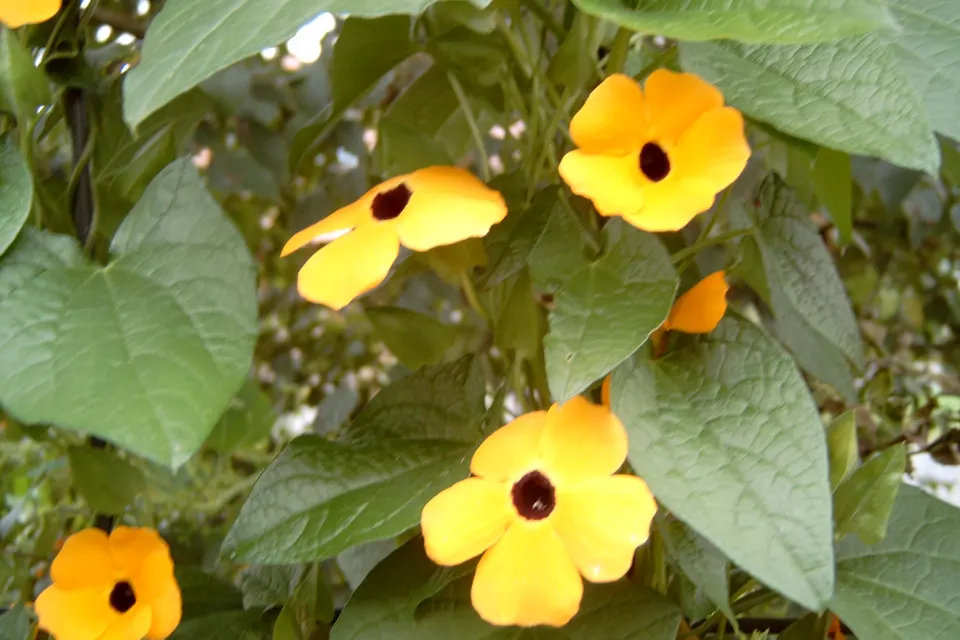
Black-eyed Susan vine shares a common name with a plant it is not related to, and the confusion is worth clearing up first.
Two different black-eyed Susans
Our black-eyed Susan is Rudbeckia, an upright perennial daisy. This is Thunbergia alata, a twining tropical vine. Both have a dark centre in an orange-yellow flower, and that is the extent of the relationship.
It needs something to twine around
NC State Extension describes it as a twining vine that does best with support near an arbour, trellis or fence. Twining matters: it wraps around a support rather than gripping it, so netting, string or thin uprights work and a solid post does not.
It runs three to eight feet, occasionally more in a long warm season.
Slow in July, good in September
The toolbox notes it blooms best after the hottest part of summer passes. A plant that looks unremarkable in midsummer is usually just early rather than failing, and pulling it in July is a common mistake.
Start it indoors about six weeks before the last frost and set it out two weeks after; it will not tolerate cold soil. It is perennial only in zones 10 and 11, so nearly everyone grows it as an annual.
Source: NC State Extension Gardener Plant Toolbox, Thunbergia alata.
Companion planting guide for Black-Eyed Susan Vine · Find your planting dates
Typically viable in USDA zones 3-11. Not sure your zone? Look it up by ZIP code.
Mature height: 3-8 ft
Method: Start indoors: Start indoors from seed, then transplant outside. It needs a head start most zones can't give it by direct-sowing alone.
When to plant black-eyed Susan vine, by zone
Every zone black-eyed Susan vine grows in. Pick your zone in the header and it will be highlighted here. Each zone links to its full page.
| Zone | Start indoors | Sow or plant out | Bloom |
|---|---|---|---|
| 3a & 3b | Apr 18–Apr 25 | Jun 13–Jun 20 | Sep 21–Sep 28 |
| 4a & 4b | Apr 3–Apr 10 | May 29–Jun 5 | Sep 6–Sep 13 |
| 5a & 5b | Mar 29–Apr 5 | May 24–May 31 | Sep 1–Sep 8 |
| 6a & 6b | Mar 14–Mar 21 | May 9–May 16 | Aug 17–Aug 24 |
| 7a & 7b | Feb 27–Mar 6 | Apr 24–May 1 | Aug 2–Aug 9 |
| 8a & 8b | Feb 11–Feb 18 | Apr 8–Apr 15 | Jul 17–Jul 24 |
| 9a & 9b | Jan 4–Jan 11 | Mar 1–Mar 8 | Jun 9–Jun 16 |
| 10a & 10b | Dec 19–Dec 26 | Feb 13–Feb 20 | May 24–May 31 |
| 11a & 11b | Nov 20–Nov 27 | Jan 15–Jan 22 | Apr 25–May 2 |
Bloom dates are about 100 days after the sow or plant-out date, not after starting seeds indoors.
See exact start-indoors, direct-sow, and harvest dates for your zone →
How many Black-Eyed Susan Vine plants fit per square foot?
Spacing: 1 per square foot (square-foot-gardening spacing). Mature height: 3-8 ft.
Where to buy black-eyed Susan vine seeds
Botanical Interests (black-eyed Susan vine seeds)
As an Amazon Associate we earn from qualifying purchases. Some links on this page also go to other retailers we may earn a commission from as an affiliate, at no extra cost to you. We only recommend products with a clear consensus of positive, independent reviews, or ones we bought and use ourselves. Each item on our gear page says which.
See it growing
Search YouTube for "growing black-eyed Susan vine" videos → (a live search, not a hand-picked video; results vary and aren't vetted by us)

Pin this for later
Growing Black-Eyed Susan Vine: A twining annual vine that flowers best after the peak of summer has passed, and no relation to Rudbeckia.
Save to Pinterest