Growing Black-Eyed Susan: A Complete Profile
By Growing Home Greens Team · July 18, 2026
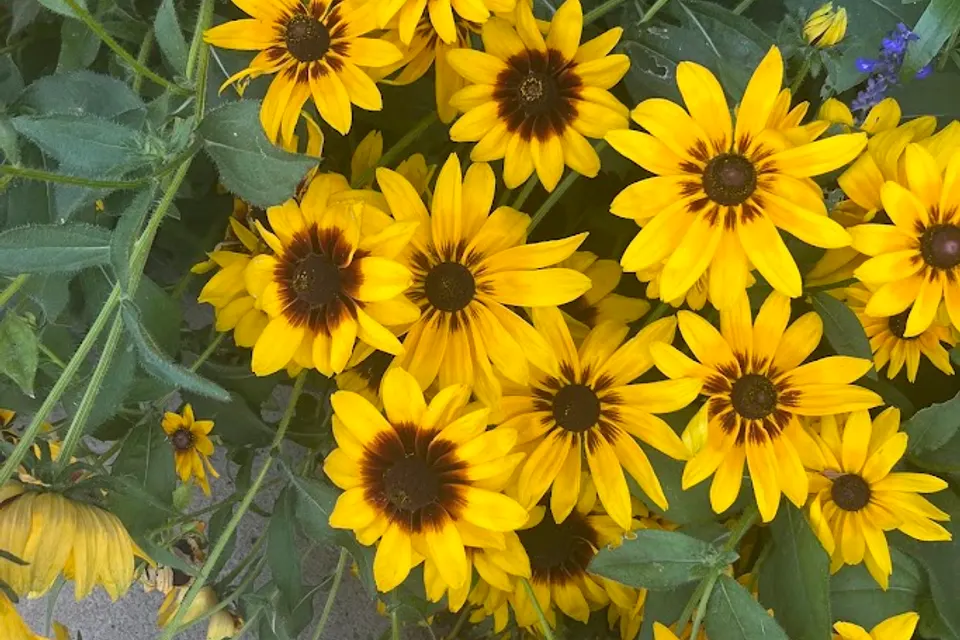
Black-eyed Susan is one of the few flowers that rewards low effort in a way that feels almost unfair. Sow it, keep it in the sun, ignore it. It germinates readily, flowers in its first summer, and carries on through drought and heat that has the rest of the border sulking, standing 2 to 3 feet tall with the classic golden-yellow daisy petals ringing a raised, dark brown-black center.
It’s technically a short-lived perennial, hardy in zones 3-9. In practice most people treat it as an annual, because it flowers so reliably from an early sowing that waiting for it to establish is beside the point.
Sowing it
Seed can go in either way. Start indoors about seven weeks before your last frost, or direct-sow outdoors roughly three weeks before it. Either way, barely cover the seed: it needs light to germinate, so pressing it onto the surface works better than burying it.
Around 70 days to bloom, at one plant per square foot. That spacing surprises people who think of it as a border filler, but a mature plant is a substantial thing and crowding it is the main cause of the problems below.
A naming note, because it causes confusion in catalogues: the common garden ‘Goldsturm’ is Rudbeckia fulgida, a different species from the R. hirta that ‘Indian Summer’, ‘Cherokee Sunset’ and ‘Prairie Sun’ belong to. Goldsturm is the tougher perennial; the hirta cultivars are showier and shorter-lived.
What goes wrong
Floppy plants with few flowers. Not enough light. This is a full-sun plant, and shade from taller neighbours costs you both bloom count and stem strength. It stretches toward whatever light it can find and then falls over.
Powdery mildew and leaf spot. Humid, crowded conditions. Give each plant its full square foot, and water at the base rather than over the top late in the day. Foliage that goes into the evening wet is what gets you.
That’s most of it. This is not a difficult plant.
Where to put it
Full sun and space. Like most daisy-family flowers it pulls pollinators into the vegetable beds around it, which is a decent argument for planting it at the end of a row of squash rather than off in a border on its own. See the full companion guide for black-eyed Susan.
At one plant per square foot it’s sized like a vegetable in the Garden Designer, not a gap-filler, so give it a planned square rather than tucking it into what’s left.
Leave the seed heads standing over winter. They’re structural in frost and the goldfinches strip them.
Sources: ‘Prairie Sun’ black-eyed Susan, University of Wisconsin-Madison Extension; ‘Indian Summer’, Fine Gardening; ‘Cherokee Sunset’, All-America Selections.
Companion planting guide for Black-Eyed Susan · Find your planting dates
Typically viable in USDA zones 2-11. Not sure your zone? Look it up by ZIP code.
Mature height: 2-3 ft
Method: Either: Start indoors for an earlier harvest, or direct-sow outside for less fuss. Either works.
When to plant black-eyed Susan, by zone
Every zone black-eyed Susan grows in. Pick your zone in the header and it will be highlighted here. Each zone links to its full page.
| Zone | Start indoors | Sow or plant out | Bloom |
|---|---|---|---|
| 2a & 2b | Apr 1–Apr 8 | Apr 29–May 6 | Jul 8–Jul 15 |
| 3a & 3b | Apr 11–Apr 18 | May 9–May 16 | Jul 18–Jul 25 |
| 4a & 4b | Mar 27–Apr 3 | Apr 24–May 1 | Jul 3–Jul 10 |
| 5a & 5b | Mar 22–Mar 29 | Apr 19–Apr 26 | Jun 28–Jul 5 |
| 6a & 6b | Mar 7–Mar 14 | Apr 4–Apr 11 | Jun 13–Jun 20 |
| 7a & 7b | Feb 20–Feb 27 | Mar 20–Mar 27 | May 29–Jun 5 |
| 8a & 8b | Feb 4–Feb 11 | Mar 4–Mar 11 | May 13–May 20 |
| 9a & 9b | Dec 28–Jan 4 | Jan 25–Feb 1 | Apr 5–Apr 12 |
| 10a & 10bFall window | Aug–Jan | Oct–Mar | ~70 days after transplanting |
| 11a & 11b | Nov 13–Nov 20 | Dec 11–Dec 18 | Feb 19–Feb 26 |
Bloom dates are about 70 days after the sow or plant-out date, not after starting seeds indoors.
Zone 2 sows before zone 3 here, which looks wrong and is not. USDA zones rank winter cold, not season length, and zone 2 is mostly interior Alaska, where hard winters come with warm summers. More on what a zone measures.
See exact start-indoors, direct-sow, and harvest dates for your zone →
How many Black-Eyed Susan plants fit per square foot?
Spacing: 1 per square foot (square-foot-gardening spacing). Mature height: 2-3 ft.
Varieties worth considering
- 'Prairie Sun': University of Wisconsin-Madison Extension singles this one out for its light green eye instead of the usual dark brown centre, and a colour pattern that stays consistent rather than varying plant to plant. A 2003 All-America Selections winner and a Fleuroselect winner. Pick it if you want something that looks deliberate rather than like a wildflower mix. (source)
- 'Indian Summer': Enormous flowers, six to nine inches across, among the largest of any Rudbeckia. Grown as an annual in most gardens. If you want cut flowers rather than a border, this is the one, though the size means it needs staking in an exposed spot. (source) Buy seeds: Botanical Interests
- 'Cherokee Sunset': Semi-double flowers, three to four inches, in golds through bronze to burgundy rather than flat yellow. A 2002 All-America Selections winner and a Fleuroselect winner; the judges specifically noted how heavily it flowers in its first year. Worth it if you find the standard yellow-and-brown a bit municipal. (source)
- 'Denver Daisy' (best for: compact borders): Clemson HGIC lists this hybrid at a compact 18-20 inches tall and 12-18 inches wide, with a distinctive mahogany eye ring between the yellow petals and dark brown center. Smaller than any of the three varieties above, bred to celebrate Denver's 150th anniversary. (source)
- 'Goldsturm' (Rudbeckia fulgida, a different species) (best for: true perennial, reliable rebloom): NC State Extension notes 'Goldsturm' is 18 to 24 inches, hardy zones 3-9, and a genuine long-lived perennial, unlike the R. hirta cultivars above which are usually grown as annuals. The 1999 Perennial Plant of the Year, the pick if you want this flower to reliably come back on its own rather than resowing. (source)
- Straight-species Rudbeckia hirta (best for: naturalized/wildflower plantings): Plain, unimproved seed rather than a bred cultivar, cheaper and the right choice for a naturalized meadow planting where uniform color and habit matter less than establishing quickly and reseeding on its own. (source)
Why each variety is listed comes from the source shown next to it. We haven't grown these ourselves yet, so treat this as a research-backed starting point, not a personal endorsement. The buy links are separate from those sources: they go to seed suppliers that sell that exact variety, and we may earn a commission on some of them.
Where to buy black-eyed Susan seeds
Botanical Interests (each supplier's black-eyed Susan seeds)
The varieties we recommend above each have their own buy links, for the suppliers that sell that exact variety.
As an Amazon Associate we earn from qualifying purchases. Some links on this page also go to other retailers we may earn a commission from as an affiliate, at no extra cost to you. We only recommend products with a clear consensus of positive, independent reviews, or ones we bought and use ourselves. Each item on our gear page says which.
See it growing
Search YouTube for "growing black-eyed Susan" videos → (a live search, not a hand-picked video; results vary and aren't vetted by us)

Pin this for later
Growing Black-Eyed Susan: Black-eyed Susan flowers the same year you sow it, takes drought without complaining, and keeps going into October. Sowing, the varieties worth buying, and the two things that go wrong.
Save to Pinterest