Growing Nasturtium: A Complete Profile
By Growing Home Greens Team · July 18, 2026
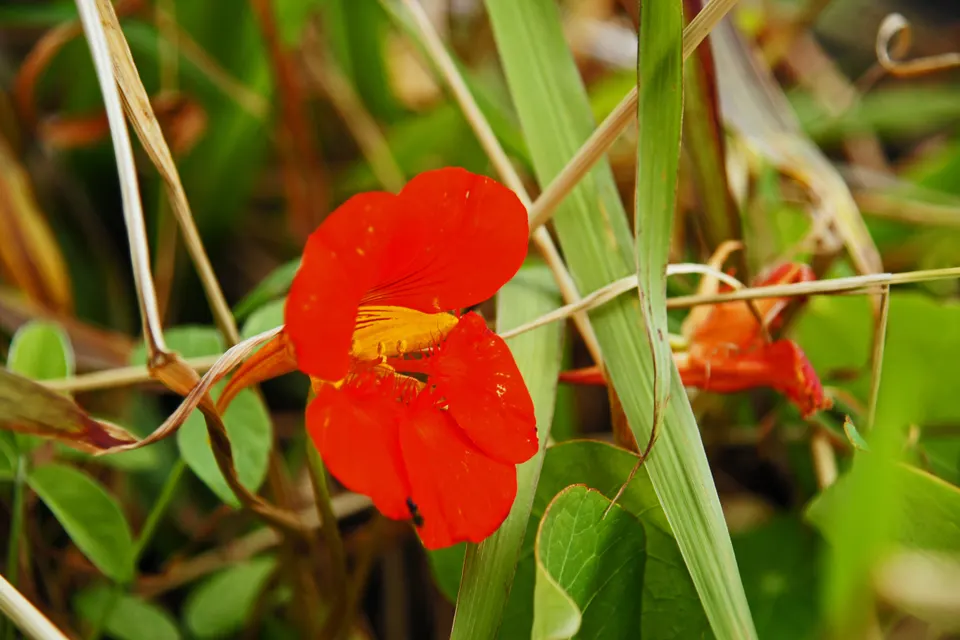
Nasturtium is one of the few flowers in a vegetable garden that earns its space with an actual job: round, lily-pad leaves and funnel-shaped blooms in orange, yellow, red, or cream, on a plant that’s either a tidy 6-inch bush or a trailing vine running several feet, depending on which type you bought. Both the peppery leaves and the flowers are edible, and the plant is widely used as a trap crop, luring aphids onto itself and away from more valuable neighbors.
Sowing and habit
Direct-sow after your last frost. Nasturtium doesn’t transplant well and germinates easily right in the ground. It’s fast and low-maintenance, reaching maturity in under two months, and unlike most flowers it prefers lean soil: heavily composted beds push it toward lush foliage and few flowers, which defeats the point if you’re relying on it to attract pollinators or work as a trap crop. Trailing varieties spread further than bush types, so know which one you planted before you count on it staying at the bed edge. A compact type like Empress of India solves that question by not spreading in the first place.
The aphids on it aren’t a problem
An aphid infestation on your nasturtium isn’t a failure. It’s usually the plant doing exactly what it’s there for, especially when it’s planted near squash or other aphid-prone crops. The bigger problem is overwatering or over-fertilizing: too-rich soil produces oversized, floppy plants with disappointing bloom, since nasturtium evolved in leaner conditions than most garden flowers.
Where to put it
Nasturtium’s role as an aphid trap crop for squash is one of its best-documented garden uses. See the full companion guide for nasturtium. At one plant per square foot, it’s compact enough for the Garden Designer to tuck along a bed edge near squash or other aphid-prone crops without crowding them out.
Sources: Empress of India Nasturtium, Johnny’s Selected Seeds.
Companion planting guide for Nasturtium · Find your planting dates
Typically viable in USDA zones 2-11. Not sure your zone? Look it up by ZIP code.
Mature height: 1-1.5 ft
Method: Direct sow: Direct-sow outside. It doesn't transplant well, or doesn't need the extra time indoors.
When to plant nasturtium, by zone
Every zone nasturtium grows in. Pick your zone in the header and it will be highlighted here. Each zone links to its full page.
| Zone | Start indoors | Sow or plant out | Bloom |
|---|---|---|---|
| 2a & 2b | Not usually | May 27–Jun 3 | Jul 21–Jul 28 |
| 3a & 3b | Not usually | Jun 6–Jun 13 | Jul 31–Aug 7 |
| 4a & 4b | Not usually | May 22–May 29 | Jul 16–Jul 23 |
| 5a & 5b | Not usually | May 17–May 24 | Jul 11–Jul 18 |
| 6a & 6b | Not usually | May 2–May 9 | Jun 26–Jul 3 |
| 7a & 7b | Not usually | Apr 17–Apr 24 | Jun 11–Jun 18 |
| 8a & 8b | Not usually | Apr 1–Apr 8 | May 26–Jun 2 |
| 9a & 9b | Not usually | Feb 22–Mar 1 | Apr 18–Apr 25 |
| 10a & 10bFall window | Not usually | Oct–Jan | ~55 days after direct-sowing |
| 11a & 11b | Not usually | Jan 8–Jan 15 | Mar 4–Mar 11 |
Bloom dates are about 55 days after the sow or plant-out date.
Zone 2 sows before zone 3 here, which looks wrong and is not. USDA zones rank winter cold, not season length, and zone 2 is mostly interior Alaska, where hard winters come with warm summers. More on what a zone measures.
See exact start-indoors, direct-sow, and harvest dates for your zone →
How many Nasturtium plants fit per square foot?
Spacing: 1 per square foot (square-foot-gardening spacing). Mature height: 1-1.5 ft.
Good companions for nasturtium
- Zucchini: Trap crop for aphids, drawing them away from squash.
Full companion guide, including what to keep away from nasturtium →
Varieties worth considering
- Empress of India (Tropaeolum majus): A compact, mounded type rather than a trailing one. If the point of planting it is to sit near squash and take the aphid hit, a plant that stays put at 16 to 20 inches does that job without swallowing the bed the way a trailing variety would. Scarlet flowers against dark blue-green foliage, and it holds its shape without staking or trimming. (source) Buy seeds: True Leaf Market · Burpee · High Mowing Organic Seeds
- Alaska Mix: Johnny's Alaska Mix has green-and-white variegated foliage, so the plant itself is decorative even before it blooms, unlike Empress of India's plain dark leaves. Same compact, mounded habit and 2-inch flowers, just in a wider mixed-color range. (source) Buy seeds: True Leaf Market · Burpee · High Mowing Organic Seeds
- Jewel Mix: Johnny's Jewel Mix includes both single and double blooms in red, pink, orange, and yellow at a slightly taller 16 inches, against Empress of India's single-form flowers and Alaska's variegated leaves. Pick it if you want some of the flowers doubled rather than uniformly single. (source) Buy seeds: True Leaf Market
Why each variety is listed comes from the source shown next to it. We haven't grown these ourselves yet, so treat this as a research-backed starting point, not a personal endorsement. The buy links are separate from those sources: they go to seed suppliers that sell that exact variety, and we may earn a commission on some of them.
Where to buy nasturtium seeds
Botanical Interests · True Leaf Market · Burpee · High Mowing Organic Seeds (each supplier's nasturtium seeds)
The varieties we recommend above each have their own buy links, for the suppliers that sell that exact variety.
As an Amazon Associate we earn from qualifying purchases. Some links on this page also go to other retailers we may earn a commission from as an affiliate, at no extra cost to you. We only recommend products with a clear consensus of positive, independent reviews, or ones we bought and use ourselves. Each item on our gear page says which.
See it growing
Search YouTube for "growing nasturtium" videos → (a live search, not a hand-picked video; results vary and aren't vetted by us)

Pin this for later
Growing Nasturtium: A fast, edible flower that doubles as a sacrificial trap crop for the aphids that would otherwise hit your squash.
Save to Pinterest