Growing Grapes: A Complete Profile
By Growing Home Greens Team · August 6, 2026
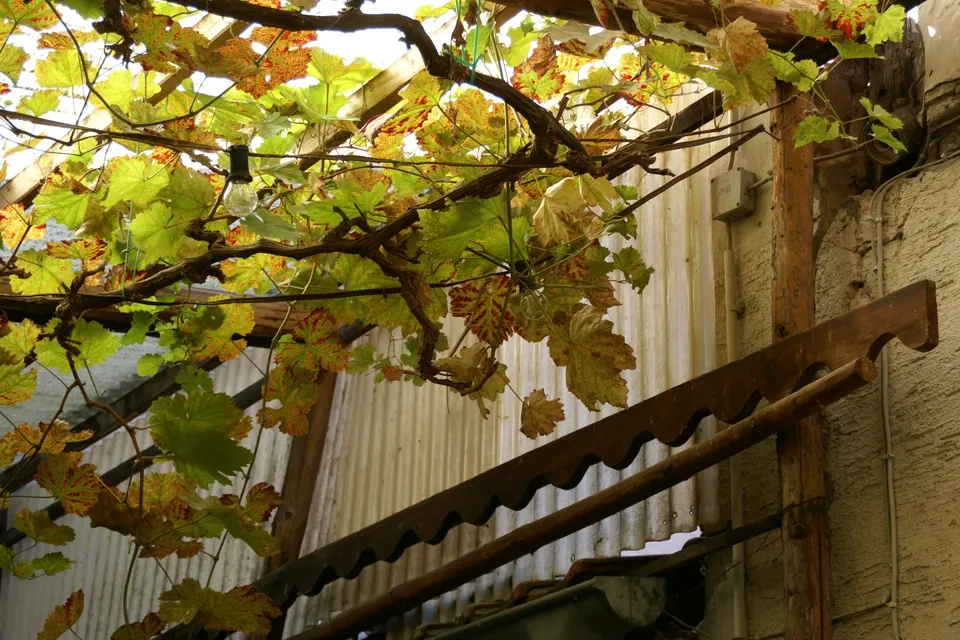
A grape vine is the largest thing on this site. One vine covers eight feet of fence or more, lives for decades, and needs one job from you each winter: a hard prune, without which you get a wall of leaves and no grapes.
It is not a raised-bed plant. It’s an arbour, fence or pergola plant, and if you plant one in a vegetable bed you will regret the decision for years.
The pruning is the crop
This is the whole thing, so it’s worth being blunt: grapes fruit on shoots that grow from one-year-old wood. Not on old wood, not on this year’s growth directly.
That means every winter you remove most of what grew last season, keeping a small number of canes from last year to produce this year’s fruiting shoots. Commercial growers remove something like 90% of the previous year’s growth. It looks like vandalism.
An unpruned vine puts everything into vegetative growth. You get a magnificent green curtain, shade over the patio, and almost no fruit. This is by far the most common reason a home grape vine disappoints, and it’s entirely fixable with a January afternoon and some nerve.
Pick for your climate, not your taste
Grapes are more climate-bound than most fruit. Roughly:
- Cold winters (zones 3-5): cold-hardy hybrids or American types. A European wine grape will die.
- Moderate (zones 5-7): American types and hybrids do well; European types need spray programmes most gardens won’t run.
- Humid south (zones 7-10): muscadine, which shrugs off the fungal diseases that ruin everything else there.
Buying the wrong species for your region is the second most common failure, and no amount of care fixes it.
What goes wrong
Loads of vine, no fruit. Pruning, almost always. See above. Occasionally too much nitrogen from a nearby lawn feed.
Fruit rots on the bunch. Poor air movement. Grapes want an open canopy, and summer leaf-thinning around the bunches helps as much as the winter prune.
Small, seedy, sour fruit. Sometimes an unthinned crop, since a vine will carry more bunches than it can ripen. Removing some in early summer makes the rest better.
Birds and wasps take the lot the week before you would have picked. Bag individual bunches, or net the vine. Wasps in particular arrive precisely at ripeness.
The wait
No meaningful fruit until year three. Years one and two are about building a trunk and a permanent framework, and pruning in those years is structural rather than about fruit. It’s a slow start followed by decades of production, which is roughly the opposite of a tomato.
Where to put it
Full sun, good air movement, and a permanent structure that can hold a heavy, woody plant. South-facing walls are traditional for a reason. The Garden Designer gives it a large footprint and marks it trellised, tall and sprawling, which is an accurate if slightly discouraging summary.
Sources: Growing grapes in the home garden, University of Minnesota Extension; Muscadine Grapes in the Home Garden, University of Georgia Extension.
Companion planting guide for Grape · Find your planting dates
Typically viable in USDA zones 4-10. Not sure your zone? Look it up by ZIP code.
Mature height: 6-10 ft
Method: Buy as a start: Buy as a nursery start and transplant outside. It's slow or unreliable from seed, so most gardeners skip seed-starting it entirely.
When to plant grape, by zone
Every zone grape grows in. Pick your zone in the header and it will be highlighted here. Each zone links to its full page.
| Zone | Start indoors | Sow or plant out | Harvest |
|---|---|---|---|
| 4a & 4b | Buy as a start | Apr 24–May 1 | First real harvest in year 3 |
| 5a & 5b | Buy as a start | Apr 19–Apr 26 | First real harvest in year 3 |
| 6a & 6b | Buy as a start | Apr 4–Apr 11 | First real harvest in year 3 |
| 7a & 7b | Buy as a start | Mar 20–Mar 27 | First real harvest in year 3 |
| 8a & 8b | Buy as a start | Mar 4–Mar 11 | First real harvest in year 3 |
| 9a & 9b | Buy as a start | Jan 25–Feb 1 | First real harvest in year 3 |
| 10a & 10b | Buy as a start | Jan 9–Jan 16 | First real harvest in year 3 |
See exact start-indoors, direct-sow, and harvest dates for your zone →
How many Grape plants fit per square foot?
Spacing: about 50 square feet per plant (square-foot-gardening spacing). Mature height: 6-10 ft.
Varieties worth considering
- American types (Vitis labrusca): Concord, Niagara and their relatives. Cold-hardy to around zone 4, disease-tolerant, slip-skin fruit with the flavour most people think of as grape juice. The default choice for a cold-climate garden. (source)
- Cold-hardy hybrids: Bred at Minnesota and Cornell for cold winters, some to zone 3-4, with better wine quality than the American types. Marquette, Frontenac and La Crescent are the names to search. (source)
- Muscadine: A different species entirely, and the answer in the humid south (zones 7-10) where European and American grapes struggle with disease. Thick-skinned, very disease-resistant, and some varieties need a pollinator vine. (source)
Why each variety is listed comes from the source shown next to it. We haven't grown these ourselves yet, so treat this as a research-backed starting point, not a personal endorsement. The buy links are separate from those sources: they go to seed suppliers that sell that exact variety, and we may earn a commission on some of them.
Where to buy grape starts
Grape is almost always bought as a nursery start rather than seeded. Check a local nursery or garden center; we haven't vetted online start/plant suppliers yet.
As an Amazon Associate we earn from qualifying purchases. Some links on this page also go to other retailers we may earn a commission from as an affiliate, at no extra cost to you. We only recommend products with a clear consensus of positive, independent reviews, or ones we bought and use ourselves. Each item on our gear page says which.
See it growing
Search YouTube for "growing grape" videos → (a live search, not a hand-picked video; results vary and aren't vetted by us)

Pin this for later
Growing Grape: A grape vine fruits on shoots from last year's wood, so the winter pruning is the crop. Which type suits your climate, and why an unpruned vine gives you leaves and nothing else.
Save to Pinterest