Growing Escarole (Endive): A Complete Profile
By Growing Home Greens Team · August 10, 2026
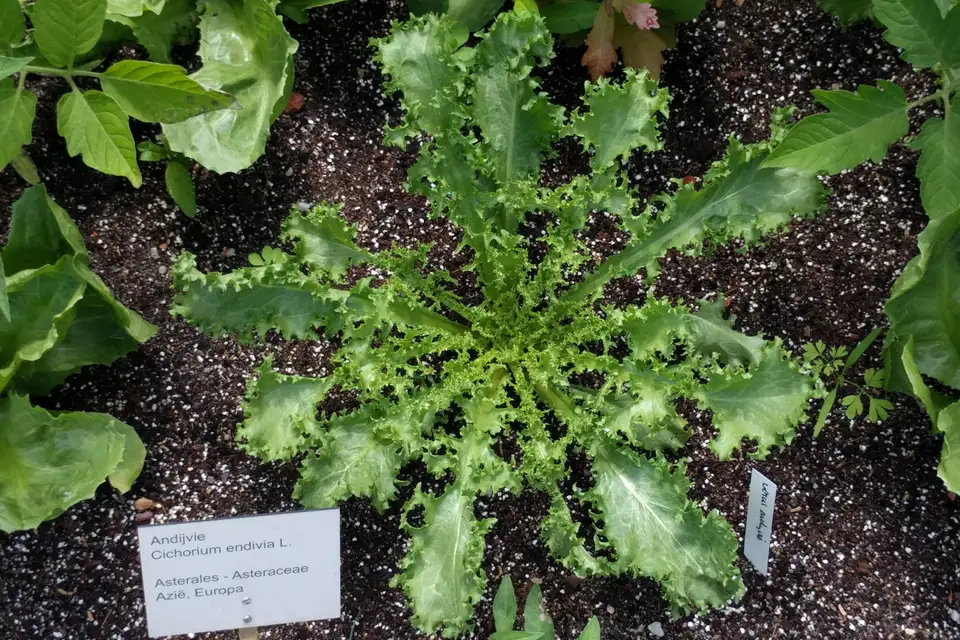
Escarole and endive are frilly-to-broad-leaved chicory relatives that head up right in the garden and are eaten as a slightly bitter salad green, distinct from the Belgian endive already covered on this site, which is dug and forced in total darkness instead.
A genuine cool-weather crop
Escarole is hardy and can be planted as early as the soil can be worked, growing best at 60-65°F. The seed can enter thermal dormancy above 77°F, so hot-weather sowings need careful variety selection or should be avoided. Optimum germination happens at 60-68°F soil temperature.
Spacing helps it blanch itself
Transplanting is recommended, sown 3 to 4 weeks before planting out with the seed barely covered in fine vermiculite. Direct-seeding also works, a quarter to a half inch deep, though it adds 14 to 21 days to maturity compared to transplanting. Space plants closely, 8 to 10 inches apart; the tight spacing helps shade the inner leaves and encourages the plant’s natural self-blanching habit. Succession sow every 3 weeks for a continuous supply.
Force a whiter blanch if wanted
The varieties sold here are self-blanching as they mature, but for a more thorough white or cream blanch, rest a 4-to-6-inch cardboard disk or plate over the center of the plant about 3 days before harvest to exclude light. Harvest whole heads with a knife just above the root attachment, then cool quickly in cold water.
Escarole has no well-established companion pairings, and nothing it needs to be kept away from. At 2 plants per square foot, it’s a reliable cool-season salad green for the Garden Designer, planted in succession through spring and fall.
Source: Chicory: Endive & Escarole: Key Growing Information, Johnny’s Selected Seeds.
Companion planting guide for Escarole (Endive) · Find your planting dates
Typically viable in USDA zones 2-11. Not sure your zone? Look it up by ZIP code.
Mature height: 0.5-1 ft
Method: Either: Start indoors for an earlier harvest, or direct-sow outside for less fuss. Either works.
When to plant escarole (endive), by zone
Every zone escarole (endive) grows in. Pick your zone in the header and it will be highlighted here. Each zone links to its full page.
| Zone | Start indoors | Sow or plant out | Harvest |
|---|---|---|---|
| 2a & 2b | Apr 22–Apr 29 | May 6–May 13 | Jul 30–Aug 6 |
| 3a & 3b | May 2–May 9 | May 16–May 23 | Aug 9–Aug 16 |
| 4a & 4b | Apr 17–Apr 24 | May 1–May 8 | Jul 25–Aug 1 |
| 5a & 5b | Apr 12–Apr 19 | Apr 26–May 3 | Jul 20–Jul 27 |
| 6a & 6bSpring window | Mar 28–Apr 4 | Apr 11–Apr 18 | Jul 5–Jul 12 |
| Fall window | Not usually | Jul 8–Jul 22 | Oct 1–Oct 15 |
| 7a & 7bSpring window | Mar 13–Mar 20 | Mar 27–Apr 3 | Jun 20–Jun 27 |
| Fall window | Not usually | Jul 18–Aug 1 | Oct 11–Oct 25 |
| 8a & 8bSpring window | Feb 25–Mar 4 | Mar 11–Mar 18 | Jun 4–Jun 11 |
| Fall window | Not usually | Aug 3–Aug 17 | Oct 27–Nov 10 |
| 9a & 9bSpring window | Jan 18–Jan 25 | Feb 1–Feb 8 | Apr 27–May 4 |
| Fall window | Not usually | Aug 28–Sep 11 | Nov 21–Dec 5 |
| 10a & 10bSpring window | Jan 2–Jan 9 | Jan 16–Jan 23 | Apr 11–Apr 18 |
| Fall window | Not usually | Sep 12–Sep 26 | Dec 6–Dec 20 |
| 11a & 11bFall window | Not usually | Sep–Mar | ~85 days after planting |
Harvest dates are about 85 days after the sow or plant-out date, not after starting seeds indoors.
Zone 2 sows before zone 3 here, which looks wrong and is not. USDA zones rank winter cold, not season length, and zone 2 is mostly interior Alaska, where hard winters come with warm summers. More on what a zone measures.
See exact start-indoors, direct-sow, and harvest dates for your zone →
How many Escarole (Endive) plants fit per square foot?
Spacing: 2 per square foot (square-foot-gardening spacing). Mature height: 0.5-1 ft.
Varieties worth considering
- 'Benefine' endive: Johnny's Selected Seeds describes this as producing fancy blanched leaves suited to frisée salad mixes, one of their standard endive offerings. (source)
- 'Eros' escarole (best for: early harvest): Johnny's Selected Seeds lists this as its earliest escarole, with dark green leaves on a compact plant, the one to grow if a short season is the main constraint. (source)
- 'Eliance' escarole (best for: heat tolerance): Johnny's Selected Seeds describes this as upright and slow to bolt, a better choice than Eros for a longer or warmer harvest window. (source)
Why each variety is listed comes from the source shown next to it. We haven't grown these ourselves yet, so treat this as a research-backed starting point, not a personal endorsement. The buy links are separate from those sources: they go to seed suppliers that sell that exact variety, and we may earn a commission on some of them.
Where to buy escarole seeds
High Mowing Organic Seeds (each supplier's escarole seeds)
As an Amazon Associate we earn from qualifying purchases. Some links on this page also go to other retailers we may earn a commission from as an affiliate, at no extra cost to you. We only recommend products with a clear consensus of positive, independent reviews, or ones we bought and use ourselves. Each item on our gear page says which.
See it growing
Search YouTube for "growing escarole (endive)" videos → (a live search, not a hand-picked video; results vary and aren't vetted by us)
%3A%20A%20frilly-to-broad-leaved%20chicory%20relative%20that%20heads%20up%20in%20the%20garden%20and%20is%20eaten%20as%20a%20slightly%20bitter%20salad%20green%2C%20distinct%20from%20the%20forced%20Belgian%20endive%20already%20covered%20here.)
Pin this for later
Growing Escarole (Endive): A frilly-to-broad-leaved chicory relative that heads up in the garden and is eaten as a slightly bitter salad green, distinct from the forced Belgian endive already covered here.
Save to Pinterest