Growing Verbena: A Complete Profile
By Growing Home Greens Team · July 18, 2026
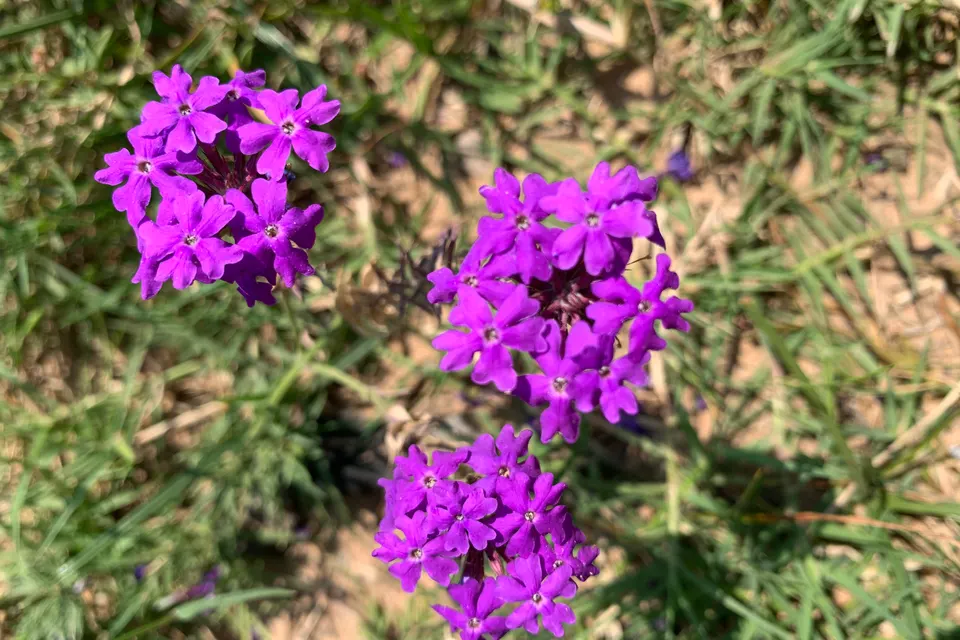
Verbena is a low, spreading groundcover flower, 6 to 12 inches at most, that does most of its work at ground level, filling gaps between taller plants and covering bare soil with tight, flat-topped clusters of small purple, pink, red, or white flowers through the hot months.
Sowing it straight into the ground
Direct sow about a week after your last frost. Exact seed depth isn’t well documented across sources, but the general guidance is to cover lightly rather than bury it. An Arizona gardening source specifically recommends scattering seed straight into the landscape near drip emitters rather than starting it in pots, which fits verbena’s low-fuss, direct-sow nature generally. At half a plant per square foot, give it room to spread; it’s often grouped with desert marigold in native and desert-style plantings, and it fills in as a sprawling mat rather than staying in a tidy clump.
Leggy growth means not enough sun
Sparse, leggy growth usually traces back to too little sun. Verbena wants full sun to perform as the dense, spreading mat it’s known for. If germination is patchy, it’s often a seed-depth issue in either direction: buried too deep and it won’t emerge, left fully exposed and it dries out before it can root.
A groundcover for the edges, not a square of its own
Verbena has no well-established companion pairings, and nothing it needs to be kept away from. Its spreading, low-growing habit makes it a natural fit for edges and gaps in the Garden Designer rather than a dedicated square of its own.
Companion planting guide for Verbena · Find your planting dates
Typically viable in USDA zones 5-10. Not sure your zone? Look it up by ZIP code.
Mature height: 0.5-1 ft
Method: Either: Start indoors for an earlier harvest, or direct-sow outside for less fuss. Either works.
When to plant verbena, by zone
Every zone verbena grows in. Pick your zone in the header and it will be highlighted here. Each zone links to its full page.
| Zone | Start indoors | Sow or plant out | Bloom |
|---|---|---|---|
| 5a & 5b | Mar 1–Mar 8 | May 17–May 24 | Aug 5–Aug 12 |
| 6a & 6b | Feb 14–Feb 21 | May 2–May 9 | Jul 21–Jul 28 |
| 7a & 7b | Jan 30–Feb 6 | Apr 17–Apr 24 | Jul 6–Jul 13 |
| 8a & 8b | Jan 14–Jan 21 | Apr 1–Apr 8 | Jun 20–Jun 27 |
| 9a & 9b | Dec 7–Dec 14 | Feb 22–Mar 1 | May 13–May 20 |
| 10a & 10bFall window | Not usually | Sep–Nov | ~80 days after planting |
Bloom dates are about 80 days after the sow or plant-out date, not after starting seeds indoors.
See exact start-indoors, direct-sow, and harvest dates for your zone →
How many Verbena plants fit per square foot?
Spacing: about 2 square feet per plant (square-foot-gardening spacing). Mature height: 0.5-1 ft.
Varieties worth considering
- Homestead Purple: Clemson Cooperative Extension's Home & Garden Information Center calls it one of the most popular trailing verbenas, citing excellent heat tolerance and profuse blooming from early spring until fall frost, a good default if you don't have a strong color preference. (source)
- Tapien series: Clemson HGIC describes fine, lacy foliage covered in small flowers from early summer to frost, resistant to powdery mildew, in colors from lavender and salmon to powder blue and pure white. Worth choosing over Homestead Purple specifically where mildew has been a recurring problem. (source)
- Superbena series: NC State Extension's Plant Toolbox lists it as a mounding habit that becomes more spreading over the season, available in many colors. A reasonable third option if neither Homestead Purple nor Tapien's color range has what you're after. (source)
Why each variety is listed comes from the source shown next to it. We haven't grown these ourselves yet, so treat this as a research-backed starting point, not a personal endorsement. The buy links are separate from those sources: they go to seed suppliers that sell that exact variety, and we may earn a commission on some of them.
Where to buy verbena seeds
True Leaf Market (each supplier's verbena seeds)
As an Amazon Associate we earn from qualifying purchases. Some links on this page also go to other retailers we may earn a commission from as an affiliate, at no extra cost to you. We only recommend products with a clear consensus of positive, independent reviews, or ones we bought and use ourselves. Each item on our gear page says which.
See it growing
Search YouTube for "growing verbena" videos → (a live search, not a hand-picked video; results vary and aren't vetted by us)

Pin this for later
Growing Verbena: A low, spreading bloomer best scattered straight into the bed rather than fussed over in pots first.
Save to Pinterest