Growing Shasta Daisy: A Complete Profile
By Growing Home Greens Team · July 29, 2026
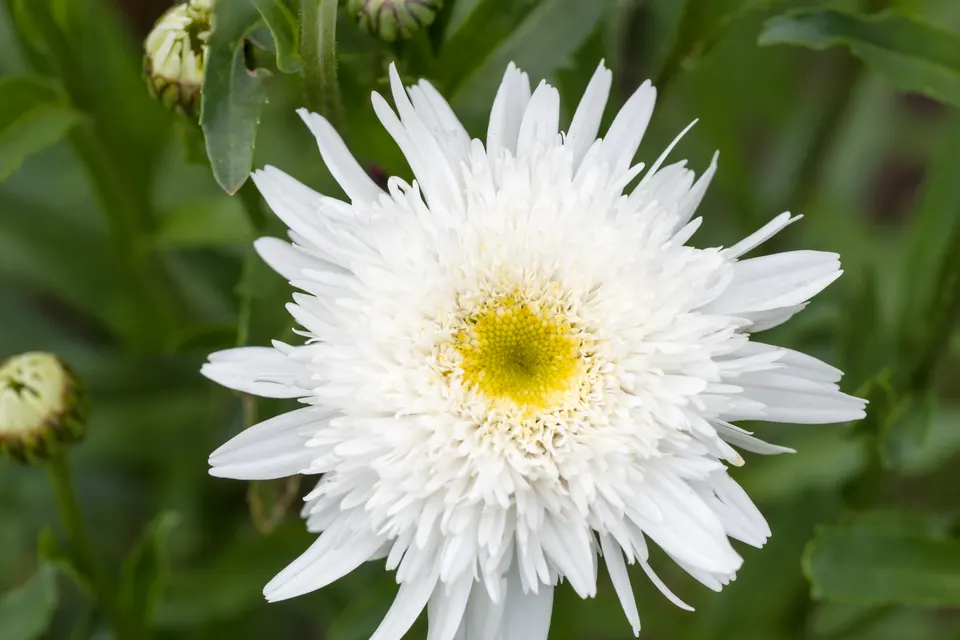
Shasta daisy is a reliable, cold-hardy perennial with the classic white-petaled, yellow-centered daisy look, and it’s a solid pollinator draw once it’s established and blooming at full size.
Starting it from seed
Shasta daisy is flexible on start method: sow indoors about 7 weeks before your last frost, or direct-sow about 3 weeks before it, either way, scatter seed on the soil surface and leave it uncovered, since it needs light to germinate. Expect about 105 days to first bloom, though as a perennial grown from seed, it often doesn’t bloom as heavily as it will in future years until its second season.
The first year is the weak one
A first-year planting that blooms lightly isn’t a failure. It’s the normal pattern for a perennial establishing from seed, and bloom typically fills in noticeably by the second year. Established clumps benefit from dividing every few years; a congested clump blooms less and is more prone to flopping over. Staking helps most cultivars get through a heavy bloom flush, but it’s one less thing to manage if you started with a sturdy-stemmed cultivar like ‘Becky’ in the first place.
A reliable long-term pollinator border
Shasta daisy has no well-established companion pairings, and nothing it needs to be kept away from. As a reliable perennial pollinator draw, it’s a solid long-term border pick in the Garden Designer near a vegetable bed that benefits from more bee and butterfly traffic.
Sources: Leucanthemum × superbum ‘Becky’, Missouri Botanical Garden Plant Finder.
Companion planting guide for Shasta Daisy · Find your planting dates
Typically viable in USDA zones 4-9. Not sure your zone? Look it up by ZIP code.
Mature height: 1.5-2.5 ft
Method: Either: Start indoors for an earlier harvest, or direct-sow outside for less fuss. Either works.
When to plant Shasta daisy, by zone
Every zone Shasta daisy grows in. Pick your zone in the header and it will be highlighted here. Each zone links to its full page.
| Zone | Start indoors | Sow or plant out | Bloom |
|---|---|---|---|
| 4a & 4b | Mar 27–Apr 3 | Apr 24–May 1 | Aug 7–Aug 14 |
| 5a & 5b | Mar 22–Mar 29 | Apr 19–Apr 26 | Aug 2–Aug 9 |
| 6a & 6b | Mar 7–Mar 14 | Apr 4–Apr 11 | Jul 18–Jul 25 |
| 7a & 7b | Feb 20–Feb 27 | Mar 20–Mar 27 | Jul 3–Jul 10 |
| 8a & 8b | Feb 4–Feb 11 | Mar 4–Mar 11 | Jun 17–Jun 24 |
| 9a & 9b | Dec 28–Jan 4 | Jan 25–Feb 1 | May 10–May 17 |
Bloom dates are about 105 days after the sow or plant-out date, not after starting seeds indoors.
See exact start-indoors, direct-sow, and harvest dates for your zone →
How many Shasta Daisy plants fit per square foot?
Spacing: 1 per square foot (square-foot-gardening spacing). Mature height: 1.5-2.5 ft.
Varieties worth considering
- Becky (Leucanthemum × superbum 'Becky'): Most Shasta daisies flop once the flower heads get heavy, especially in a crowded or partly shaded bed. 'Becky' grows on stiff, rigid stems that stand up at 3 to 4 feet without staking, which is the single biggest headache this plant otherwise causes. (source)
- 'Snowcap': Missouri Botanical Garden lists this as notably compact, just 15-18 inches against Becky's 3-4 feet, with the same large 4 inch single daisies. Its short form resists weather damage better than the taller types, a different solution to the flopping problem than Becky's stiff stems. (source)
- 'Crazy Daisy': A double-flowered type Missouri Botanical Garden lists at 2-2.5 feet, with frilly, twisted white rays instead of the flat single petals of Becky or Snowcap. The pick if you want a fuller, ruffled bloom rather than the classic simple daisy shape. (source) Buy seeds: True Leaf Market
Why each variety is listed comes from the source shown next to it. We haven't grown these ourselves yet, so treat this as a research-backed starting point, not a personal endorsement. The buy links are separate from those sources: they go to seed suppliers that sell that exact variety, and we may earn a commission on some of them.
Where to buy Shasta daisy seeds
True Leaf Market · Burpee (each supplier's Shasta daisy seeds)
The varieties we recommend above each have their own buy links, for the suppliers that sell that exact variety.
As an Amazon Associate we earn from qualifying purchases. Some links on this page also go to other retailers we may earn a commission from as an affiliate, at no extra cost to you. We only recommend products with a clear consensus of positive, independent reviews, or ones we bought and use ourselves. Each item on our gear page says which.
See it growing
Search YouTube for "growing Shasta daisy" videos → (a live search, not a hand-picked video; results vary and aren't vetted by us)

Pin this for later
Growing Shasta Daisy: A classic white perennial daisy that takes a year to hit its full stride. Patience in year one pays off after that.
Save to Pinterest