Growing Scabiosa (Pincushion Flower): A Complete Profile
By Growing Home Greens Team · July 25, 2026
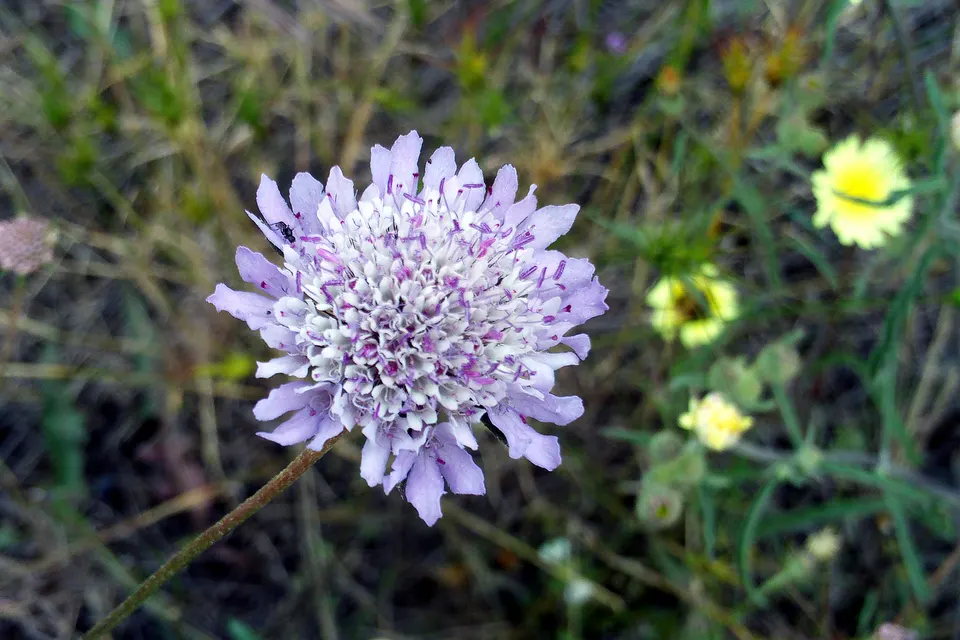
Scabiosa is the one most people know by its common name, pincushion flower, which describes it better than the botanical one does: a domed centre studded with pale stamens sitting on a ring of petals, on a stem thin enough that the flower nods when the wind gets up.
It is one of the few things you can sow in February and cut in July. Most perennials make you wait a year.
Sowing it
Start seed indoors six to eight weeks before your last frost. Barely cover it, because it wants light to germinate, and press it into the surface rather than burying it. Transplant out once frost danger has passed.
From seed to first flower is a long haul, roughly 105 to 140 days, which is why the indoor start matters. Sow it directly in May and you’ll spend the summer looking at leaves.
There are two plants sold under this name and they behave differently. The annual (Scabiosa atropurpurea) is the one that comes in burgundy, mauve, pink and near-black, with smaller flowers. The perennial (Scabiosa caucasica) runs to blues and whites with larger blooms, up to three inches across. Both are worth growing; just know which packet you bought, because only one of them is coming back.
What goes wrong
It flowers too early, while it’s still small. This is the classic scabiosa failure and it happens indoors, before the plant ever reaches the garden. Seedlings kept too warm rush into bud instead of putting on size, and you end up transplanting something that is already flowering on a four-inch stem. Keep them at 60-65°F once they’ve germinated. Cooler and slower is the goal.
It stops flowering in midsummer. Usually because nobody cut it. Scabiosa is a cut-and-come-again flower in the literal sense: every stem you take triggers more. Leave the spent blooms on and it reads that as a finished season and starts setting seed. Cut it hard, even if you have nowhere to put the flowers.
It flops. Those wiry stems are the plant’s whole appeal and also its weakness in an exposed spot. Grow it close enough that the plants hold each other up, or run a layer of netting horizontally at about a foot and let the stems grow up through it.
Where to put it
Full sun and air moving through it. In a cutting bed it does well planted at a spacing that feels slightly too tight, because a crowded block of scabiosa supports itself and produces longer, straighter stems reaching for light.
If you’re growing it to cut, harvest when the flower is about half open. Fully open blooms in the garden are lovely and last about two days in water.
Sources: Fama Deep Blue, Black Knight and Salmon Rose, Johnny’s Selected Seeds; Scabiosa columbaria, NC State Extension.
Companion planting guide for Scabiosa (Pincushion Flower) · Find your planting dates
Typically viable in USDA zones 3-10. Not sure your zone? Look it up by ZIP code.
Mature height: 1.5-2.5 ft
Method: Start indoors: Start indoors from seed, then transplant outside. It needs a head start most zones can't give it by direct-sowing alone.
When to plant scabiosa (pincushion flower), by zone
Every zone scabiosa (pincushion flower) grows in. Pick your zone in the header and it will be highlighted here. Each zone links to its full page.
| Zone | Start indoors | Sow or plant out | Bloom |
|---|---|---|---|
| 3a & 3b | Apr 11–Apr 18 | Jun 6–Jun 13 | Oct 4–Oct 11 |
| 4a & 4b | Mar 27–Apr 3 | May 22–May 29 | Sep 19–Sep 26 |
| 5a & 5b | Mar 22–Mar 29 | May 17–May 24 | Sep 14–Sep 21 |
| 6a & 6b | Mar 7–Mar 14 | May 2–May 9 | Aug 30–Sep 6 |
| 7a & 7b | Feb 20–Feb 27 | Apr 17–Apr 24 | Aug 15–Aug 22 |
| 8a & 8b | Feb 4–Feb 11 | Apr 1–Apr 8 | Jul 30–Aug 6 |
| 9a & 9b | Dec 28–Jan 4 | Feb 22–Mar 1 | Jun 22–Jun 29 |
| 10a & 10b | Dec 12–Dec 19 | Feb 6–Feb 13 | Jun 6–Jun 13 |
Bloom dates are about 120 days after the sow or plant-out date, not after starting seeds indoors.
See exact start-indoors, direct-sow, and harvest dates for your zone →
How many Scabiosa (Pincushion Flower) plants fit per square foot?
Spacing: 1 per square foot (square-foot-gardening spacing). Mature height: 1.5-2.5 ft.
Varieties worth considering
- Fama Deep Blue: The one most cut-flower growers settle on. Blooms are 2.5-3.5 inches on long, clean, wiry stems, and it holds in a vase. Perennial in zones 3-7. (source)
- Black Knight: Almost-black flowers, 1.5-2.5 inches, on strong slender stems. Smaller than the Fama series but the colour is the point: it reads nearly black in a bouquet and there isn't much else that does. (source) Buy seeds: Botanical Interests
- Salmon Rose: A coral-toned annual, 1.5-2.5 inch blooms on 24-36 inch stems, bred for cutting and reported to draw in beneficial insects while it's at it. The one to pick if Fama's blue and Black Knight's near-black both feel too cool for the bed you're filling. (source)
- 'Oxford Blue' (best for: cutting, uniform stems): Johnny's lists 1.5- to 2.5-inch lavender-blue blooms on strong, slender 24- to 36-inch stems, similar scale to Fama Deep Blue but with more uniform, elegant stems bred specifically for cutting. (source)
- 'Butterfly Blue' (Scabiosa columbaria, perennial) (best for: true perennial, long bloom season): NC State Extension lists this at a compact 12-18 inches, blooming from May into fall in zones 5a-9b, a genuine perennial compared to the annual S. atropurpurea varieties above. Choose it if you want scabiosa to reliably come back rather than resowing every spring. (source)
- 'Ping Pong' (best for: dried arrangements): Round pale blue blooms give way to papery maroon-and-green seed pods that dry into silvery-white heads, useful for dried arrangements in a way none of the cut-fresh varieties above are. Grow it for the seed heads as much as the flower itself. (source)
Why each variety is listed comes from the source shown next to it. We haven't grown these ourselves yet, so treat this as a research-backed starting point, not a personal endorsement. The buy links are separate from those sources: they go to seed suppliers that sell that exact variety, and we may earn a commission on some of them.
Where to buy scabiosa seeds
Botanical Interests · High Mowing Organic Seeds (each supplier's scabiosa seeds)
The varieties we recommend above each have their own buy links, for the suppliers that sell that exact variety.
As an Amazon Associate we earn from qualifying purchases. Some links on this page also go to other retailers we may earn a commission from as an affiliate, at no extra cost to you. We only recommend products with a clear consensus of positive, independent reviews, or ones we bought and use ourselves. Each item on our gear page says which.
See it growing
Search YouTube for "growing scabiosa (pincushion flower)" videos → (a live search, not a hand-picked video; results vary and aren't vetted by us)
%3A%20Pincushion%20flower%20blooms%20in%20its%20first%20year%20from%20seed%20and%20keeps%20going%20all%20season%2C%20as%20long%20as%20you%20keep%20cutting%20it.%20What%20to%20sow%2C%20and%20which%20varieties%20earn%20the%20space.)
Pin this for later
Growing Scabiosa (Pincushion Flower): Pincushion flower blooms in its first year from seed and keeps going all season, as long as you keep cutting it. What to sow, and which varieties earn the space.
Save to Pinterest