Growing Peas: A Complete Profile
By Growing Home Greens Team · July 18, 2026
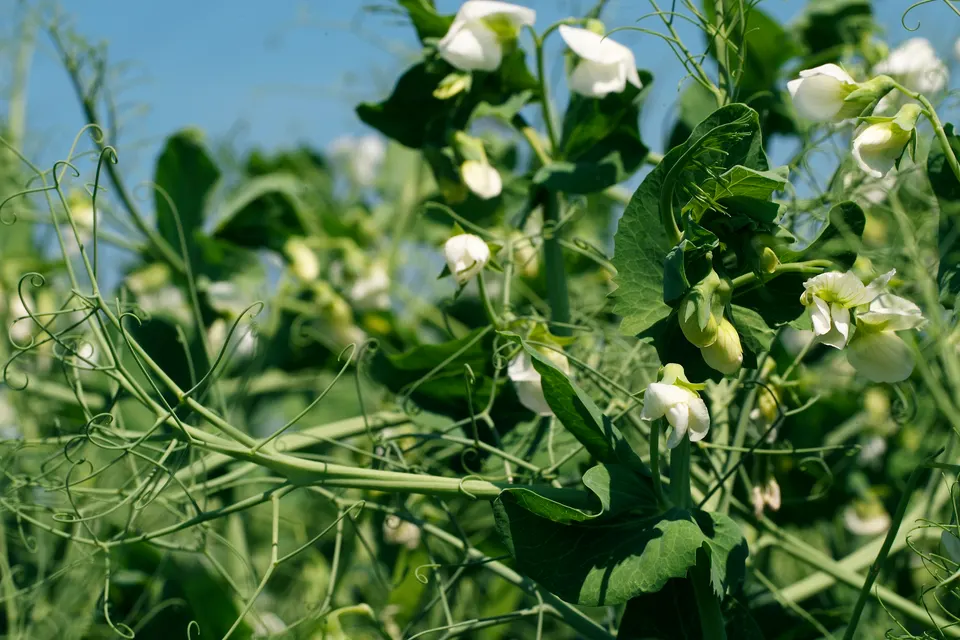
Peas are one of the few crops meant to go in the ground while it’s still cold, direct-sown weeks before your last frost, while most of the garden is still just a plan on paper. They’re also one of the few nitrogen-fixers in a typical vegetable bed, quietly benefiting whatever gets planted near their roots.
Sowing it into soil most crops would sulk in
Direct-sow seeds an inch or two deep about 6 weeks before your last frost. Peas want the cold and will germinate in soil most other crops would sulk in. Most varieties climb, so give them a trellis, netting, or fence from the start rather than trying to add support after the vines are already sprawled across the ground. At 8 plants per square foot, they’re dense but shallow-rooted, which is part of why they pair well with deeper-rooted crops nearby.
Mildew that shows up as the season warms
A powdery white coating on the leaves late in the pea season is powdery mildew. It tends to show up as the weather warms, which is one of the reasons pea season is naturally short in most climates. Poor pod set usually traces back to heat: peas stop setting pods reliably once temperatures climb, so a late planting often trades yield for a longer window.
A nitrogen source that needs a trellis
Peas fix nitrogen that benefits neighboring root crops like carrots. See the full companion guide for peas. Keep them away from onions, garlic, leeks, and chives, all of which inhibit the nitrogen-fixing bacteria peas depend on. Because peas need vertical support, plan their spot in the Garden Designer along a fence line or trellis rather than out in open bed space where a cage would have to be added later.
Companion planting guide for Pea · Find your planting dates
Typically viable in USDA zones 2-11. Not sure your zone? Look it up by ZIP code.
Mature height: 3-6 ft
Method: Direct sow: Direct-sow outside. It doesn't transplant well, or doesn't need the extra time indoors.
When to plant pea, by zone
Every zone pea grows in. Pick your zone in the header and it will be highlighted here. Each zone links to its full page.
| Zone | Start indoors | Sow or plant out | Harvest |
|---|---|---|---|
| 2a & 2bSpring window | Not usually | Apr 8–Apr 15 | Jun 7–Jun 14 |
| Fall window | Not usually | Jun 19–Jul 3 | Aug 18–Sep 1 |
| 3a & 3bSpring window | Not usually | Apr 18–Apr 25 | Jun 17–Jun 24 |
| Fall window | Not usually | Jun 23–Jul 7 | Aug 22–Sep 5 |
| 4a & 4bSpring window | Not usually | Apr 3–Apr 10 | Jun 2–Jun 9 |
| Fall window | Not usually | Jul 8–Jul 22 | Sep 6–Sep 20 |
| 5a & 5bSpring window | Not usually | Mar 29–Apr 5 | May 28–Jun 4 |
| Fall window | Not usually | Jul 23–Aug 6 | Sep 21–Oct 5 |
| 6a & 6bSpring window | Not usually | Mar 14–Mar 21 | May 13–May 20 |
| Fall window | Not usually | Aug 2–Aug 16 | Oct 1–Oct 15 |
| 7a & 7bSpring window | Not usually | Feb 27–Mar 6 | Apr 28–May 5 |
| Fall window | Not usually | Aug 12–Aug 26 | Oct 11–Oct 25 |
| 8a & 8bSpring window | Not usually | Feb 11–Feb 18 | Apr 12–Apr 19 |
| Fall window | Not usually | Aug 28–Sep 11 | Oct 27–Nov 10 |
| 9a & 9bSpring window | Not usually | Jan 4–Jan 11 | Mar 5–Mar 12 |
| Fall window | Not usually | Sep 22–Oct 6 | Nov 21–Dec 5 |
| 10a & 10bFall window | Not usually | Sep–Jan | ~60 days after direct-sowing |
| 11a & 11bFall window | Not usually | Nov–Feb | ~60 days after direct-sowing |
Harvest dates are about 60 days after the sow or plant-out date.
Zone 2 sows before zone 3 here, which looks wrong and is not. USDA zones rank winter cold, not season length, and zone 2 is mostly interior Alaska, where hard winters come with warm summers. More on what a zone measures.
See exact start-indoors, direct-sow, and harvest dates for your zone →
How many Pea plants fit per square foot?
Spacing: 8 per square foot (square-foot-gardening spacing). Mature height: 3-6 ft.
Soil & water: pH 6-6.5. Needs well-drained soil. Amend with lime if soil pH falls below 6.
Good companions for pea
- Carrot: Peas fix nitrogen that benefits neighboring root crops.
Full companion guide, including what to keep away from pea →
Varieties worth considering
- Cascadia (snap pea): Cornell's disease-resistant vegetable variety list credits Cascadia with resistance to common wilt, fusarium wilt, pea enation mosaic virus, pea/bean leaf roll virus, and powdery mildew, a broadly resistant option worth considering if mildew has been a recurring problem in your peas. (source) Buy seeds: Botanical Interests · True Leaf Market · High Mowing Organic Seeds
- Green Arrow (shelling pea): Cornell's list credits it with the broadest resistance profile among shelling types: curly top virus, common wilt, downy mildew, fusarium wilt and powdery mildew all at once. The pick if you want traditional shelling peas rather than an edible-pod snap type like Cascadia. (source) Buy seeds: Botanical Interests · True Leaf Market · High Mowing Organic Seeds
- Sugar Snap (snap pea): The original snap pea, per Cornell resistant to common wilt and fusarium wilt. Narrower resistance than Cascadia, but it's the variety that started the whole edible-pod-snap category and remains a widely available default. (source) Buy seeds: Botanical Interests · Burpee
Why each variety is listed comes from the source shown next to it. We haven't grown these ourselves yet, so treat this as a research-backed starting point, not a personal endorsement. The buy links are separate from those sources: they go to seed suppliers that sell that exact variety, and we may earn a commission on some of them.
Where to buy pea seeds
Botanical Interests · True Leaf Market · Burpee · High Mowing Organic Seeds (each supplier's pea seeds)
The varieties we recommend above each have their own buy links, for the suppliers that sell that exact variety.
As an Amazon Associate we earn from qualifying purchases. Some links on this page also go to other retailers we may earn a commission from as an affiliate, at no extra cost to you. We only recommend products with a clear consensus of positive, independent reviews, or ones we bought and use ourselves. Each item on our gear page says which.
See it growing
Search YouTube for "growing pea" videos → (a live search, not a hand-picked video; results vary and aren't vetted by us)

Pin this for later
Growing Pea: A true cold-season crop, sown weeks before your last frost while the rest of the garden is still waiting.
Save to Pinterest