Growing Ornamental Allium: A Complete Profile
By Growing Home Greens Team · July 18, 2026
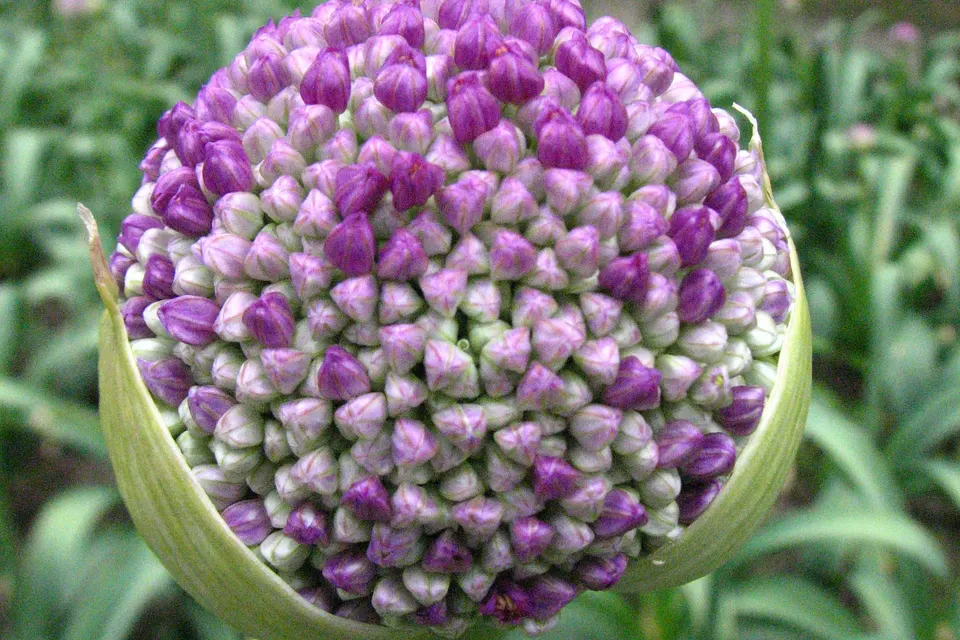
Ornamental allium is the flowering relative of the onion you eat, grown for its round, spiky flower heads on tall bare stems rather than for anything edible. It blooms in the awkward late-spring gap after tulips finish and before most perennials are in full swing, which is exactly why gardeners plant it.
Planting in fall, for a bloom that’s far off
Plant bulbs in fall like other hardy spring bulbs, timed to your zone. It’s slower to establish than tulips or daffodils, closer to 200 days from planting to bloom, and the flower heads sit well above the foliage on long, leafless stems, so the leaves themselves aren’t part of the display and often start yellowing before or during bloom. That’s normal, not a problem, and it’s worth planting something in front of the base to hide the fading foliage.
Ragged foliage at bloom time is normal
Foliage that looks ragged or yellow right as the flower is at its best is just how allium grows, the leaves aren’t ornamental and fade on their own schedule, unrelated to the bloom above them. Weak or absent flowering usually traces back to bulbs planted too shallow or in soil that stayed wet over winter; like other alliums, it wants good drainage. One advantage over most spring bulbs: deer, rabbits, and most insects tend to leave it alone, so pest damage is rarely the cause of a disappointing bloom.
Filling the gap after tulips, before peonies
Allium’s bloom timing (after tulips, before peonies and iris) makes it useful for stretching color through a gap most gardens have in late spring, and its strong pollinator draw is worth pairing with other flowering plants; see the full companion guide for ornamental allium. Plan its spot in the Garden Designer with something lower and leafy in front of it to cover the fading foliage while the flower heads do their work up top.
Companion planting guide for Ornamental Allium · Find your planting dates
Typically viable in USDA zones 3-8. Not sure your zone? Look it up by ZIP code.
Mature height: 2-3 ft
Method: Direct sow: Direct-sow outside. It doesn't transplant well, or doesn't need the extra time indoors.
When to plant ornamental allium, by zone
Every zone ornamental allium grows in. Pick your zone in the header and it will be highlighted here. Each zone links to its full page.
| Zone | Start indoors | Sow or plant out | Bloom |
|---|---|---|---|
| 3a & 3bFall window | Not usually | Sep–Nov | ~195 days after direct-sowing |
| 4a & 4bFall window | Not usually | Sep–Nov | ~195 days after direct-sowing |
| 5a & 5bFall window | Not usually | Sep–Nov | ~195 days after direct-sowing |
| 6a & 6bFall window | Not usually | Sep–Nov | ~195 days after direct-sowing |
| 7a & 7bFall window | Not usually | Sep–Nov | ~195 days after direct-sowing |
| 8a & 8bFall window | Not usually | Sep–Nov | ~195 days after direct-sowing |
Bloom dates are about 195 days after the sow or plant-out date.
See exact start-indoors, direct-sow, and harvest dates for your zone →
How many Ornamental Allium plants fit per square foot?
Spacing: 5 per square foot (square-foot-gardening spacing). Mature height: 2-3 ft.
Varieties worth considering
- 'Globemaster': Iowa State University Extension calls it 'one of the most reliable and impactful alliums you can plant in the garden', its softball-to-volleyball-size flower heads are the largest of the commonly grown ornamental alliums. (source)
- 'Purple Sensation': Iowa State describes baseball-sized violet-purple heads on 20-30 inch stems, noticeably smaller and shorter than Globemaster. A better fit for a bed that can't spare the room Globemaster's larger scale needs. (source)
- Allium christophii (Star of Persia): Iowa State lists this as an airier, star-shaped cluster, 10-12 inches wide on shorter 12-20 inch stems, that dries to a silvery tan and holds for 2-3 weeks. The pick for a looser, more open look than the tight spheres of Globemaster or Purple Sensation. (source)
Why each variety is listed comes from the source shown next to it. We haven't grown these ourselves yet, so treat this as a research-backed starting point, not a personal endorsement. The buy links are separate from those sources: they go to seed suppliers that sell that exact variety, and we may earn a commission on some of them.
Where to buy ornamental allium bulbs
We haven't vetted bulb/tuber suppliers yet. Our seed-supplier list doesn't carry these.
As an Amazon Associate we earn from qualifying purchases. Some links on this page also go to other retailers we may earn a commission from as an affiliate, at no extra cost to you. We only recommend products with a clear consensus of positive, independent reviews, or ones we bought and use ourselves. Each item on our gear page says which.
See it growing
Search YouTube for "growing ornamental allium" videos → (a live search, not a hand-picked video; results vary and aren't vetted by us)

Pin this for later
Growing Ornamental Allium: The flowering onion whose globe-shaped blooms fill the gap between spring bulbs and summer perennials.
Save to Pinterest