Growing Lupine: A Complete Profile
By Growing Home Greens Team · July 18, 2026
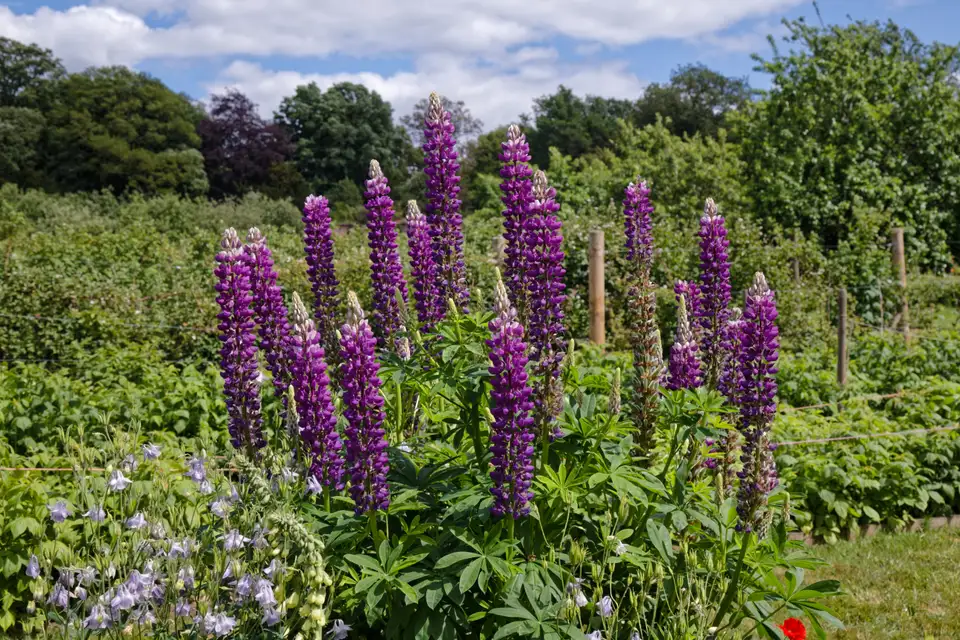
Lupine is a nitrogen-fixing legume, but don’t expect a quick soil boost from it. That nitrogen only becomes available to other plants once the foliage and roots break down, not while the plant is actively growing. It’s grown here mainly for its tall, dense spires of pea-like blooms, and it has a strong climate preference worth knowing before planting: it wants mild summers and struggles badly in low-desert heat.
Scarifying and soaking before it goes in the ground
Scarify the seed coat and soak seed for 12-24 hours before direct-sowing about 2 weeks before your last frost. Perennial types often put on a modest show the first year and bloom much more heavily in their second, so don’t judge the plant on year one alone. It needs generous room (only half a plant per square foot) reflecting how much space its root system and foliage spread. Note that some parts of the plant are toxic to pets and livestock, worth keeping in mind if animals have access to the bed.
Seed that never comes up is a prep problem
Seed that never germinates is almost always a prep problem. Skipping the scarify-and-soak step leaves the hard seed coat intact and unable to take up water. Weak or absent bloom in a hot-summer climate isn’t a care mistake; lupine underperforms outside zones 4-8, and pushing it into low-desert heat is fighting the plant’s basic biology rather than a fixable technique issue.
A nitrogen contribution that pays off after it’s gone
Lupine has no well-established companion pairings, and nothing it needs to be kept away from. Its wide half-square-foot spacing means it needs room in the Garden Designer rather than being tucked into gaps, and its nitrogen contribution only pays off for whatever’s planted in that same spot after it’s cut back and decomposed.
Companion planting guide for Lupine · Find your planting dates
Typically viable in USDA zones 4-8. Not sure your zone? Look it up by ZIP code.
Mature height: 2-4 ft
Method: Direct sow: Direct-sow outside. It doesn't transplant well, or doesn't need the extra time indoors.
When to plant lupine, by zone
Every zone lupine grows in. Pick your zone in the header and it will be highlighted here. Each zone links to its full page.
| Zone | Start indoors | Sow or plant out | Bloom |
|---|---|---|---|
| 4a & 4b | Not usually | May 1–May 8 | Jul 20–Jul 27 |
| 5a & 5b | Not usually | Apr 26–May 3 | Jul 15–Jul 22 |
| 6a & 6b | Not usually | Apr 11–Apr 18 | Jun 30–Jul 7 |
| 7a & 7b | Not usually | Mar 27–Apr 3 | Jun 15–Jun 22 |
| 8a & 8b | Not usually | Mar 11–Mar 18 | May 30–Jun 6 |
Bloom dates are about 80 days after the sow or plant-out date.
See exact start-indoors, direct-sow, and harvest dates for your zone →
How many Lupine plants fit per square foot?
Spacing: about 2 square feet per plant (square-foot-gardening spacing). Mature height: 2-4 ft.
Varieties worth considering
- Russell Hybrids: SDSU Extension specifically recommends this cultivar as hardy enough for Northern Great Plains gardens, where the school grows it successfully at its own trial gardens, a good pick if you're in a colder, mild-summer zone rather than trying to push lupine into heat. (source)
- Tutti Frutti series: Also recommended by SDSU Extension for Northern Great Plains hardiness, alongside Russell Hybrids, giving a second reliable option if the first isn't available. (source)
- Minarett series: SDSU Extension lists this as a true dwarf, 20 inches, against Russell Hybrids' roughly 30. Choose it for a shorter bed or front-of-border spot where the taller series would flop over its neighbors. (source)
Why each variety is listed comes from the source shown next to it. We haven't grown these ourselves yet, so treat this as a research-backed starting point, not a personal endorsement. The buy links are separate from those sources: they go to seed suppliers that sell that exact variety, and we may earn a commission on some of them.
Where to buy lupine seeds
Botanical Interests · Burpee (each supplier's lupine seeds)
As an Amazon Associate we earn from qualifying purchases. Some links on this page also go to other retailers we may earn a commission from as an affiliate, at no extra cost to you. We only recommend products with a clear consensus of positive, independent reviews, or ones we bought and use ourselves. Each item on our gear page says which.
See it growing
Search YouTube for "growing lupine" videos → (a live search, not a hand-picked video; results vary and aren't vetted by us)

Pin this for later
Growing Lupine: A nitrogen-fixing legume grown for its spires of pea-like blooms, best in mild-summer climates, and often better in its second year.
Save to Pinterest