Growing Liatris (Blazing Star): A Complete Profile
By Growing Home Greens Team · August 20, 2026
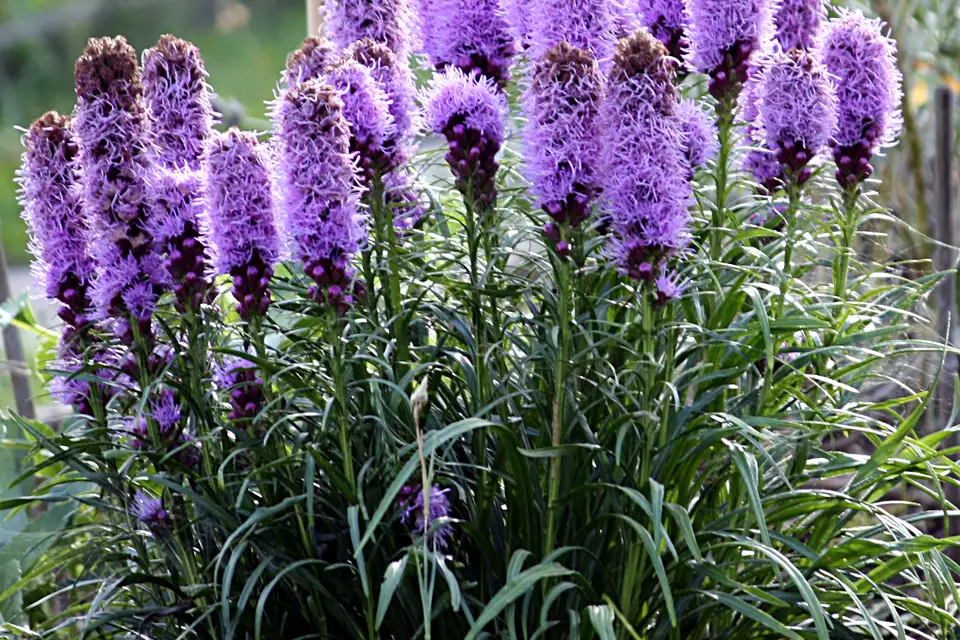
Liatris is a North American native grown from a corm, and it does two things backwards compared with everything else in the bed.
It flowers from the top down
Most spikes open from the bottom up. Liatris opens at the tip and works downwards, which means a half-open spike looks like it is dying from below when it is doing exactly what it should. Cut for a vase, this is why it holds well.
Leave the dead stems standing
NC State Extension records that native bees nest in the dead hollow stems, alongside the plant attracting bees, butterflies and moths and serving as a larval host. Cutting it to the ground in autumn removes that habitat. Leave the stems until spring.
Tall and narrow
Three to six feet tall on a footprint of three inches to a foot and a half. That narrow base is useful: it can hold the north edge of a bed without shading much of what is behind it.
Hardy zones 3 through 8, full sun. It grows from a corm rather than seed for most gardeners, so the buy-seeds guidance elsewhere on this site does not apply to it.
Source: NC State Extension Gardener Plant Toolbox, Liatris spicata.
Companion planting guide for Liatris (Blazing Star) · Find your planting dates
Typically viable in USDA zones 3-8. Not sure your zone? Look it up by ZIP code.
Mature height: 3-6 ft
Method: Direct sow: Direct-sow outside. It doesn't transplant well, or doesn't need the extra time indoors.
When to plant liatris (blazing star), by zone
Every zone liatris (blazing star) grows in. Pick your zone in the header and it will be highlighted here. Each zone links to its full page.
| Zone | Start indoors | Sow or plant out | Bloom |
|---|---|---|---|
| 3a & 3b | Not usually | May 16–May 23 | First real harvest the season after planting |
| 4a & 4b | Not usually | May 1–May 8 | First real harvest the season after planting |
| 5a & 5b | Not usually | Apr 26–May 3 | First real harvest the season after planting |
| 6a & 6b | Not usually | Apr 11–Apr 18 | First real harvest the season after planting |
| 7a & 7b | Not usually | Mar 27–Apr 3 | First real harvest the season after planting |
| 8a & 8b | Not usually | Mar 11–Mar 18 | First real harvest the season after planting |
See exact start-indoors, direct-sow, and harvest dates for your zone →
How many Liatris (Blazing Star) plants fit per square foot?
Spacing: 1 per square foot (square-foot-gardening spacing). Mature height: 3-6 ft.
Where to buy liatris bulbs
We haven't vetted bulb/tuber suppliers yet. Our seed-supplier list doesn't carry these.
As an Amazon Associate we earn from qualifying purchases. Some links on this page also go to other retailers we may earn a commission from as an affiliate, at no extra cost to you. We only recommend products with a clear consensus of positive, independent reviews, or ones we bought and use ourselves. Each item on our gear page says which.
See it growing
Search YouTube for "growing liatris (blazing star)" videos → (a live search, not a hand-picked video; results vary and aren't vetted by us)
%3A%20A%20native%20prairie%20perennial%20that%20flowers%20from%20the%20top%20down%20and%20feeds%20stem-nesting%20bees%20over%20winter.)
Pin this for later
Growing Liatris (Blazing Star): A native prairie perennial that flowers from the top down and feeds stem-nesting bees over winter.
Save to Pinterest