Growing Four O'Clocks: A Complete Profile
By Growing Home Greens Team · July 18, 2026
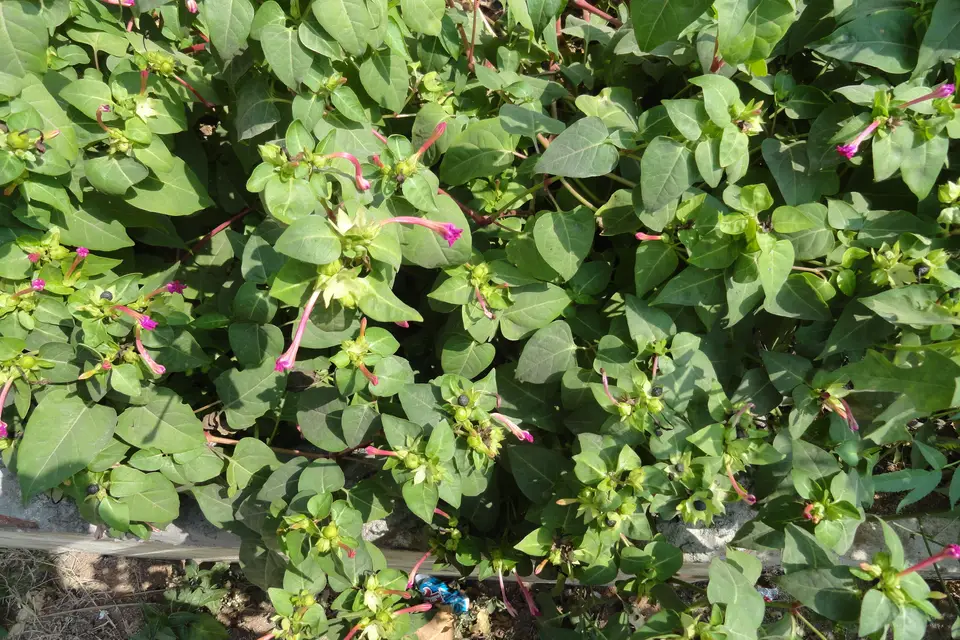
Four o’clocks are named for exactly what they do: the trumpet-shaped flowers, pink, red, yellow, white, or speckled bicolor, stay closed most of the day and pop open in late afternoon, releasing a strong sweet fragrance that carries into the evening. It’s a low-effort plant to get started, the seed is large and easy to handle, nothing like the dust-fine seed of many other flowers, but it needs plenty of room once it’s growing.
Sowing it and giving it room
Direct sow about a week after your last frost date, seed pointed roughly 1/4 to 1/2 inch deep. Germination is quick and reliable for such a large seed. By midsummer each plant fills out into a bushy, sprawling mound 2 to 4 feet wide, so the 0.5-per-square-foot spacing isn’t a typo. This is one of the few flowers on this site that needs a full square foot or more to itself. Give it a spot at the back or corner of a bed where its bulk won’t shade out smaller neighbors. Most seed sold is an unnamed color mix; ‘Limelight’ is worth seeking out by name if you want chartreuse foliage along with the flowers.
The flowers aren’t “stuck,” they’re on schedule
The most common complaint is disappointment that the flowers “won’t open.” They’re doing exactly what they’re supposed to, just not on a morning-gardener’s schedule. If plants stay stunted or fail to sprawl, check they weren’t crowded at planting; this species fights hard for space once mature, and undersized specimens are usually just packed too tight. In zones below roughly 9, expect it to die back at frost like any other annual. The tuberous root can be dug and stored over winter the same way dahlias are, but it isn’t worth the effort unless you’re attached to a specific plant.
A corner planting, not something tucked in
Four o’clock has no well-established companion pairings, and nothing it needs to be kept away from. Because it needs so much lateral room, plan its spot in the Garden Designer as a dedicated corner or border rather than trying to tuck it between other plants.
Sources: Four O’Clocks, Mirabilis jalapa, University of Wisconsin-Madison Division of Extension.
Companion planting guide for Four O'Clock · Find your planting dates
Typically viable in USDA zones 2-11. Not sure your zone? Look it up by ZIP code.
Mature height: 2-3 ft
Method: Direct sow: Direct-sow outside. It doesn't transplant well, or doesn't need the extra time indoors.
When to plant four o'clock, by zone
Every zone four o'clock grows in. Pick your zone in the header and it will be highlighted here. Each zone links to its full page.
| Zone | Start indoors | Sow or plant out | Bloom |
|---|---|---|---|
| 2a & 2b | Not usually | May 27–Jun 3 | Aug 5–Aug 12 |
| 3a & 3b | Not usually | Jun 6–Jun 13 | Aug 15–Aug 22 |
| 4a & 4b | Not usually | May 22–May 29 | Jul 31–Aug 7 |
| 5a & 5b | Not usually | May 17–May 24 | Jul 26–Aug 2 |
| 6a & 6b | Not usually | May 2–May 9 | Jul 11–Jul 18 |
| 7a & 7b | Not usually | Apr 17–Apr 24 | Jun 26–Jul 3 |
| 8a & 8b | Not usually | Apr 1–Apr 8 | Jun 10–Jun 17 |
| 9a & 9b | Not usually | Feb 22–Mar 1 | May 3–May 10 |
| 10a & 10bSpring window | Not usually | Mar–Jun | ~70 days after direct-sowing |
| 11a & 11b | Not usually | Jan 8–Jan 15 | Mar 19–Mar 26 |
Bloom dates are about 70 days after the sow or plant-out date.
Zone 2 sows before zone 3 here, which looks wrong and is not. USDA zones rank winter cold, not season length, and zone 2 is mostly interior Alaska, where hard winters come with warm summers. More on what a zone measures.
See exact start-indoors, direct-sow, and harvest dates for your zone →
How many Four O'Clock plants fit per square foot?
Spacing: about 2 square feet per plant (square-foot-gardening spacing). Mature height: 2-3 ft.
Varieties worth considering
- 'Limelight' (Mirabilis jalapa): University of Wisconsin Extension describes it as a chartreuse-leaved sport of the standard green-leaved plant, with the same neon pink evening flowers. If you want four o'clocks for the foliage as much as the fragrance, this is the one to look for by name rather than buying an unnamed mixed-color packet. (source)
- 'Broken Colors': Wisconsin Extension describes bicolor flowers with striped, splashed or marbled patterns across pink, red, white and yellow, on the standard green foliage. The pick if you want pattern variety within a single planting rather than Limelight's solid-color chartreuse look. (source) Buy seeds: Botanical Interests
- 'Marbles' series: Also listed by Wisconsin Extension, with irregularly striped and splotched bicolor flowers in White-Red, White-Yellow, Yellow-Red and Tricolor variants. Similar novelty-pattern appeal to Broken Colors, in a named series with more specific color-pair options. (source)
Why each variety is listed comes from the source shown next to it. We haven't grown these ourselves yet, so treat this as a research-backed starting point, not a personal endorsement. The buy links are separate from those sources: they go to seed suppliers that sell that exact variety, and we may earn a commission on some of them.
Where to buy four o'clock seeds
Burpee (each supplier's four o'clock seeds)
The varieties we recommend above each have their own buy links, for the suppliers that sell that exact variety.
As an Amazon Associate we earn from qualifying purchases. Some links on this page also go to other retailers we may earn a commission from as an affiliate, at no extra cost to you. We only recommend products with a clear consensus of positive, independent reviews, or ones we bought and use ourselves. Each item on our gear page says which.
See it growing
Search YouTube for "growing four o'clock" videos → (a live search, not a hand-picked video; results vary and aren't vetted by us)

Pin this for later
Growing Four O'Clock: A sprawling, fragrance-forward annual whose flowers open on their own schedule each afternoon, not yours.
Save to Pinterest