Growing Celeriac: A Complete Profile
By Growing Home Greens Team · July 24, 2026
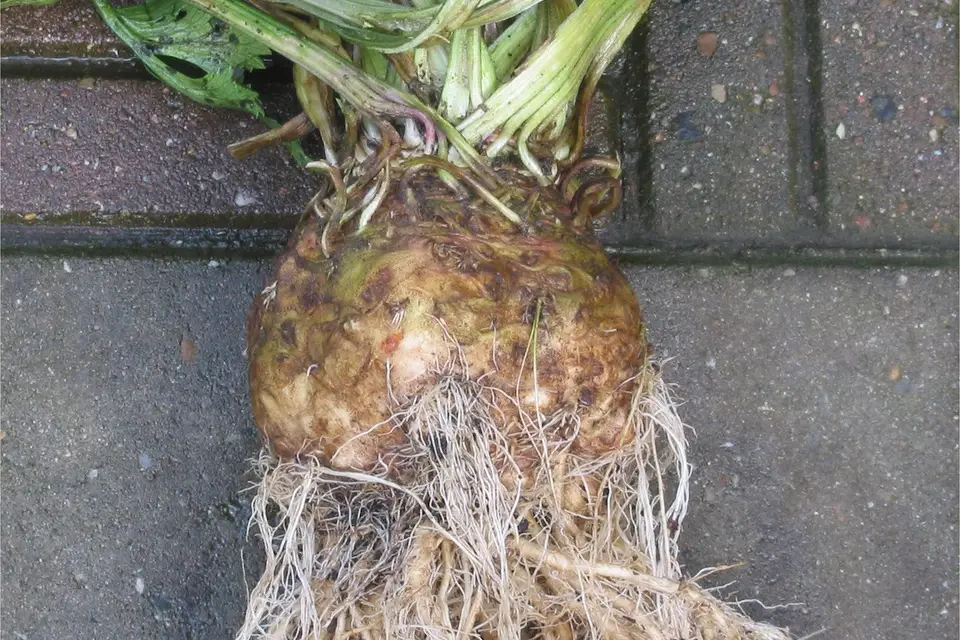
Celeriac is celery bred in the other direction: same species, but the plant puts its effort into a swollen root instead of stalks. It comes out of the ground looking like a knot of pale roots wrapped round a cricket ball, and once you’ve peeled it, it tastes like celery that has calmed down. Grated raw into a remoulade or roasted in chunks, it earns its space.
It is also, honestly, one of the slower things you can grow. Sow in February, dig in October.
Sowing it
Start seed indoors about ten weeks before your last frost. The seed is tiny and slow, often two to three weeks to germinate, and it wants light, so press it into the surface rather than covering it.
Transplant out about two weeks before your last frost date once the seedlings have a few true leaves. Celeriac tolerates a light frost better than it tolerates being planted into cold, dry soil.
From there, the whole crop comes down to one thing: water. Celeriac has a shallow root system and a long season, and every dry spell it goes through shows up as a smaller root in autumn. If you have a soaker hose, this is the crop to put it on.
What goes wrong
The root stays small. Almost always water, sometimes feeding. Celeriac is a heavy feeder that sulks through drought and does not catch up afterwards. Mulch it, and don’t let it dry out in August when you’re paying attention to the tomatoes.
The root is hollow or pithy inside. Inconsistent watering while the root was sizing up. A drought followed by a soaking is worse than steady moderate dryness.
The leaves go brown and spotty. Usually Septoria leaf blight, splashed up from the soil by rain. Mulching helps, spacing for airflow helps, and picking a variety with upright growth like Mars helps more than either.
Side shoots everywhere and no central root. Normal. Strip the outer leaves and any side roots from around the crown in late summer so the plant concentrates on one root. It feels brutal and it works.
Where to put it
Rich, moisture-retentive soil, full sun, and somewhere you’ll walk past with a hose. Treat the bed the way you’d treat one for celery.
Leave it in the ground until the first hard frosts, then lift, cut the leaves off and store it somewhere cold and damp. It will keep until spring, which is the whole argument for growing something that took eight months.
Sources: Brilliant and Mars, Johnny’s Selected Seeds; Giant Prague, True Leaf Market.
Companion planting guide for Celeriac (Celery Root) · Find your planting dates
Typically viable in USDA zones 3-9. Not sure your zone? Look it up by ZIP code.
Mature height: 1-1.5 ft
Method: Start indoors: Start indoors from seed, then transplant outside. It needs a head start most zones can't give it by direct-sowing alone.
When to plant celeriac (celery root), by zone
Every zone celeriac (celery root) grows in. Pick your zone in the header and it will be highlighted here. Each zone links to its full page.
| Zone | Start indoors | Sow or plant out | Harvest |
|---|---|---|---|
| 3a & 3b | Mar 21–Mar 28 | May 16–May 23 | Aug 24–Aug 31 |
| 4a & 4b | Mar 6–Mar 13 | May 1–May 8 | Aug 9–Aug 16 |
| 5a & 5b | Mar 1–Mar 8 | Apr 26–May 3 | Aug 4–Aug 11 |
| 6a & 6b | Feb 14–Feb 21 | Apr 11–Apr 18 | Jul 20–Jul 27 |
| 7a & 7b | Jan 30–Feb 6 | Mar 27–Apr 3 | Jul 5–Jul 12 |
| 8a & 8b | Jan 14–Jan 21 | Mar 11–Mar 18 | Jun 19–Jun 26 |
| 9a & 9b | Dec 7–Dec 14 | Feb 1–Feb 8 | May 12–May 19 |
Harvest dates are about 100 days after the sow or plant-out date, not after starting seeds indoors.
See exact start-indoors, direct-sow, and harvest dates for your zone →
How many Celeriac (Celery Root) plants fit per square foot?
Spacing: 4 per square foot (square-foot-gardening spacing). Mature height: 1-1.5 ft.
Varieties worth considering
- Brilliant: Listed at 110 days and described as early-maturing for the crop, which tells you something about celeriac. Smooth-skinned, so less of the root is lost to peeling. (source) Buy seeds: Burpee
- Mars: Similar to Brilliant but holds better in the ground and stays firm inside even on large roots. Upright growth means less rain splash onto the crown and less Septoria blight, which is the disease that usually spoils the leaves. (source)
- Giant Prague (Large Smooth Prague): One of only two celeriac varieties on Cornell Cooperative Extension's selected list of vegetable varieties for New York gardeners, alongside Brilliant above. Cornell lists it as Large Smooth Prague, the same variety sold as Giant Prague. (source)
- 'President' (best for: clean tops, storage): Osborne lists a fast 110 days from transplant with clean, dark green, disease- and tip-burn-free tops and high uniformity, similar timing to Brilliant but with tops specifically bred to stay clean. Suitable for long storage like the others here. (source)
- 'Ibis' (best for: disease resistance, bolt tolerance): Vital Seeds notes resistance to Septoria (the leaf blight this profile calls the main foliage problem) plus bolt-hardiness for early planting under protection, a combination none of the other three varieties here specifically claim. Worth it if Septoria has been a recurring issue in your celeriac bed. (source)
- 'Monarch' (best for: smooth roots, storage): Thompson & Morgan describes very smooth, easily washable, creamy-colored roots that store well in a root cellar, a step up in skin quality over Giant Prague's rougher heirloom roots for less peeling loss. (source)
Why each variety is listed comes from the source shown next to it. We haven't grown these ourselves yet, so treat this as a research-backed starting point, not a personal endorsement. The buy links are separate from those sources: they go to seed suppliers that sell that exact variety, and we may earn a commission on some of them.
Where to buy celeriac seeds
True Leaf Market · High Mowing Organic Seeds (each supplier's celeriac seeds)
The varieties we recommend above each have their own buy links, for the suppliers that sell that exact variety.
As an Amazon Associate we earn from qualifying purchases. Some links on this page also go to other retailers we may earn a commission from as an affiliate, at no extra cost to you. We only recommend products with a clear consensus of positive, independent reviews, or ones we bought and use ourselves. Each item on our gear page says which.
See it growing
Search YouTube for "growing celeriac (celery root)" videos → (a live search, not a hand-picked video; results vary and aren't vetted by us)
%3A%20Celeriac%20takes%20half%20the%20year%20and%20looks%20like%20something%20dug%20out%20of%20a%20swamp%2C%20then%20stores%20until%20March.%20What%20it%20needs%2C%20what%20usually%20goes%20wrong%2C%20and%20which%20varieties%20to%20buy.)
Pin this for later
Growing Celeriac (Celery Root): Celeriac takes half the year and looks like something dug out of a swamp, then stores until March. What it needs, what usually goes wrong, and which varieties to buy.
Save to Pinterest