Growing Candytuft: A Complete Profile
By Growing Home Greens Team · August 20, 2026
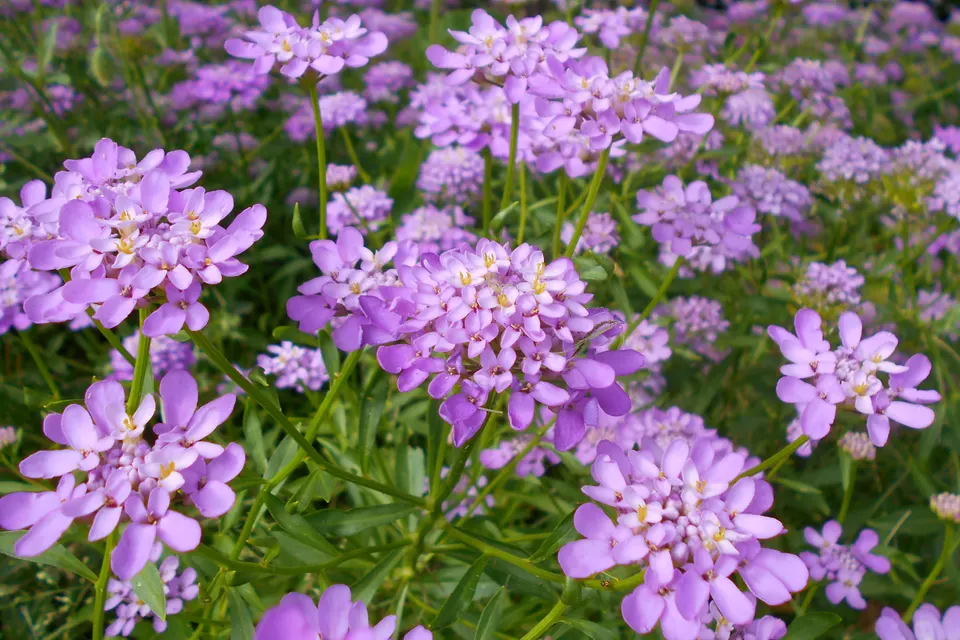
Candytuft is a short, dense annual grown for a concentrated burst of white or pink flowers in late spring.
The annual one, not the evergreen one
Two plants share this name. Iberis sempervirens is an evergreen perennial that spills over walls. Iberis umbellata, the one covered here and the one sold on seed racks, is a true annual raised fresh each year. They are not interchangeable, and the perennial will not come from an annual’s seed packet.
Weeks, not months
NC State Extension puts the bloom in May and June. That is the whole performance. Sowing in succession every couple of weeks through spring extends it, and pairing it with something that peaks in July keeps the square working after it stops.
It reaches 12 to 18 inches tall and 6 to 12 inches across, in full sun or partial shade, and takes poor soil without complaint.
Sow it early and leave it alone
Seed goes in about two weeks before the last frost, an eighth of an inch deep. It resents transplanting, which is why our calendar direct sows it rather than starting it indoors.
Four plants to the square foot gives the dense block that this plant needs to look like anything; a scattered few read as weeds.
Source: NC State Extension Gardener Plant Toolbox, Iberis umbellata.
Companion planting guide for Candytuft · Find your planting dates
Typically viable in USDA zones 2-11. Not sure your zone? Look it up by ZIP code.
Mature height: 1-1.5 ft
Method: Direct sow: Direct-sow outside. It doesn't transplant well, or doesn't need the extra time indoors.
When to plant candytuft, by zone
Every zone candytuft grows in. Pick your zone in the header and it will be highlighted here. Each zone links to its full page.
| Zone | Start indoors | Sow or plant out | Bloom |
|---|---|---|---|
| 2a & 2b | Not usually | May 6–May 13 | Jul 15–Jul 22 |
| 3a & 3b | Not usually | May 16–May 23 | Jul 25–Aug 1 |
| 4a & 4b | Not usually | May 1–May 8 | Jul 10–Jul 17 |
| 5a & 5b | Not usually | Apr 26–May 3 | Jul 5–Jul 12 |
| 6a & 6b | Not usually | Apr 11–Apr 18 | Jun 20–Jun 27 |
| 7a & 7b | Not usually | Mar 27–Apr 3 | Jun 5–Jun 12 |
| 8a & 8b | Not usually | Mar 11–Mar 18 | May 20–May 27 |
| 9a & 9b | Not usually | Feb 1–Feb 8 | Apr 12–Apr 19 |
| 10a & 10b | Not usually | Jan 16–Jan 23 | Mar 27–Apr 3 |
| 11a & 11b | Not usually | Dec 18–Dec 25 | Feb 26–Mar 5 |
Bloom dates are about 70 days after the sow or plant-out date.
Zone 2 sows before zone 3 here, which looks wrong and is not. USDA zones rank winter cold, not season length, and zone 2 is mostly interior Alaska, where hard winters come with warm summers. More on what a zone measures.
See exact start-indoors, direct-sow, and harvest dates for your zone →
How many Candytuft plants fit per square foot?
Spacing: 4 per square foot (square-foot-gardening spacing). Mature height: 1-1.5 ft.
Where to buy candytuft seeds
None of the seed suppliers we list carries candytuft seeds right now. A local garden center or a specialty seed house is the place to look.
As an Amazon Associate we earn from qualifying purchases. Some links on this page also go to other retailers we may earn a commission from as an affiliate, at no extra cost to you. We only recommend products with a clear consensus of positive, independent reviews, or ones we bought and use ourselves. Each item on our gear page says which.
See it growing
Search YouTube for "growing candytuft" videos → (a live search, not a hand-picked video; results vary and aren't vetted by us)

Pin this for later
Growing Candytuft: An annual that flowers hard for a few weeks in late spring and then quietly stops, and how it differs from the evergreen perennial with the same name.
Save to Pinterest