Growing California Poppy: A Complete Profile
By Growing Home Greens Team · July 18, 2026
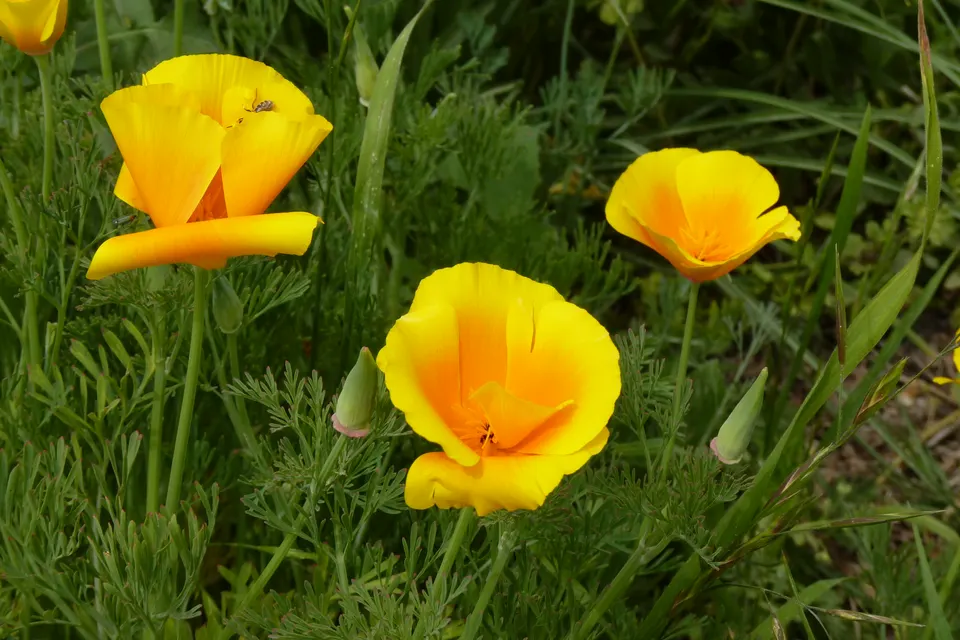
California poppy is a direct-sow-only flower, and not because it’s fussy. It’s the opposite, thriving on neglect once it’s in the ground. It stays under a foot tall, silky cup-shaped orange or yellow blooms over finely cut, blue-green ferny foliage. The catch is that the seed needs light to germinate, so anyone used to burying seed a half-inch deep will bury this one right out of viability.
Scattering seed on the surface, not burying it
Direct-sow about 2 weeks before your last frost, scattering seed on the surface or covering it no deeper than an eighth of an inch. It’s one of the first reliable pollen sources for native bees each spring, opening before a lot of the vegetable garden has even gotten going. It self-seeds readily and behaves as a short-lived perennial in zones 8-10, but is grown strictly as an annual everywhere else. Plant 2 per square foot.
Poor germination traces back to buried seed
Poor germination almost always traces back to seed buried too deep. If you’re not seeing sprouts within a couple weeks, the seed likely never got the light exposure it needed. Named cultivars like the one above won’t breed true if you let the flowers self-seed; the following year’s volunteers will drift back toward the wild orange species, which is worth knowing before you’re disappointed by year two.
An early pollen source for a gap that isn’t needed yet
California poppy has no well-established companion pairings, and nothing it needs to be kept away from. Its early bloom and 2-per-square-foot spacing make it a good filler for gaps in the Garden Designer that won’t be needed until warm-season crops go in later.
Companion planting guide for California Poppy · Find your planting dates
Typically viable in USDA zones 2-10. Not sure your zone? Look it up by ZIP code.
Mature height: 0.5-1 ft
Method: Direct sow: Direct-sow outside. It doesn't transplant well, or doesn't need the extra time indoors.
When to plant California poppy, by zone
Every zone California poppy grows in. Pick your zone in the header and it will be highlighted here. Each zone links to its full page.
| Zone | Start indoors | Sow or plant out | Bloom |
|---|---|---|---|
| 2a & 2b | Not usually | May 6–May 13 | Jul 25–Aug 1 |
| 3a & 3b | Not usually | May 16–May 23 | Aug 4–Aug 11 |
| 4a & 4b | Not usually | May 1–May 8 | Jul 20–Jul 27 |
| 5a & 5b | Not usually | Apr 26–May 3 | Jul 15–Jul 22 |
| 6a & 6b | Not usually | Apr 11–Apr 18 | Jun 30–Jul 7 |
| 7a & 7b | Not usually | Mar 27–Apr 3 | Jun 15–Jun 22 |
| 8a & 8b | Not usually | Mar 11–Mar 18 | May 30–Jun 6 |
| 9a & 9b | Not usually | Feb 1–Feb 8 | Apr 22–Apr 29 |
| 10a & 10b | Not usually | Jan 16–Jan 23 | Apr 6–Apr 13 |
Bloom dates are about 80 days after the sow or plant-out date.
Zone 2 sows before zone 3 here, which looks wrong and is not. USDA zones rank winter cold, not season length, and zone 2 is mostly interior Alaska, where hard winters come with warm summers. More on what a zone measures.
See exact start-indoors, direct-sow, and harvest dates for your zone →
How many California Poppy plants fit per square foot?
Spacing: 2 per square foot (square-foot-gardening spacing). Mature height: 0.5-1 ft.
Varieties worth considering
- XL Jelly Beans: Listed in NC State Extension's plant profile as a cultivar with vibrant pink, lemon-yellow, and red blooms over blue-green foliage, a named option if you want more color variety than the standard orange species. (source)
- Mikado: Bright red-orange petals over silvery foliage, 12-18 inches, 55-60 days per Hudson Valley Seed. Closer to the wild species' orange than XL Jelly Beans' multicolor mix, just with more saturated color and that silver-foliage contrast. (source) Buy seeds: Botanical Interests · True Leaf Market
- Thai Silk series: A silky, fluted, sometimes double-flowered mix in rosy red, peachy pink, tangerine and gold, at 10-12 inches. The most distinct-looking option here if you want the ruffled double form rather than the classic single cup shape. (source)
Why each variety is listed comes from the source shown next to it. We haven't grown these ourselves yet, so treat this as a research-backed starting point, not a personal endorsement. The buy links are separate from those sources: they go to seed suppliers that sell that exact variety, and we may earn a commission on some of them.
Where to buy California poppy seeds
True Leaf Market (California poppy seeds)
The varieties we recommend above each have their own buy links, for the suppliers that sell that exact variety.
As an Amazon Associate we earn from qualifying purchases. Some links on this page also go to other retailers we may earn a commission from as an affiliate, at no extra cost to you. We only recommend products with a clear consensus of positive, independent reviews, or ones we bought and use ourselves. Each item on our gear page says which.
See it growing
Search YouTube for "growing California poppy" videos → (a live search, not a hand-picked video; results vary and aren't vetted by us)

Pin this for later
Growing California Poppy: A surface-sown, no-transplant flower that's one of the earliest pollen sources for native bees each season.
Save to Pinterest