Growing Birdhouse Gourd: A Complete Profile
By Growing Home Greens Team · August 19, 2026
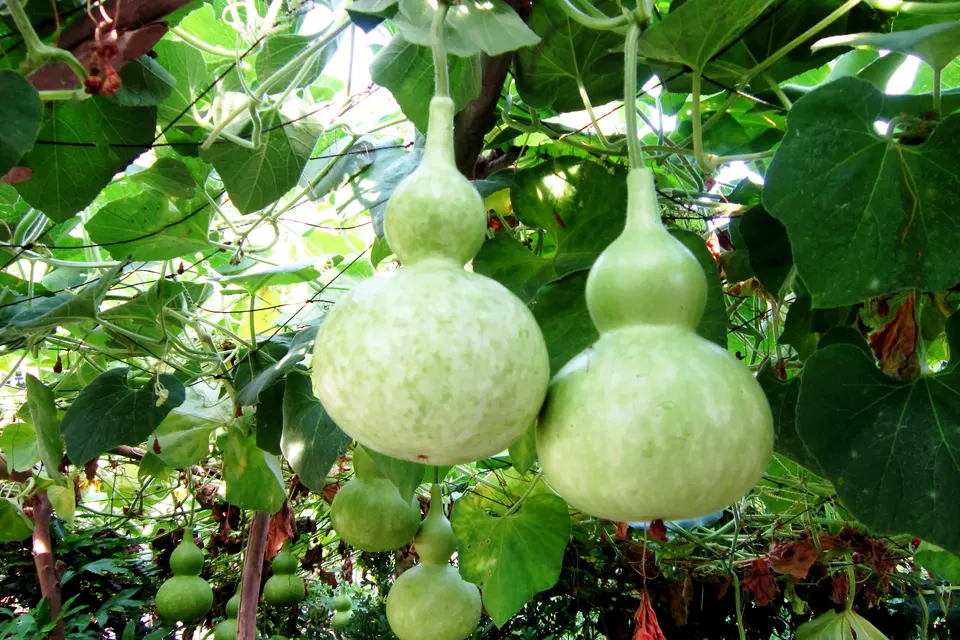
Birdhouse gourd is the one crop in this list you plant for what is left after the season ends. The fruit is inedible at maturity; you cure the shell, drill it, and hang it.
Give it more room than you think
University of New Hampshire Extension puts spacing at three to four feet between plants, and the vines still run 15 to 35 feet from there. In a square-foot bed that works out to roughly ten squares for one plant, which is why the designer flags it as a sprawler. The honest options are a corner square with a sturdy trellis, or an edge where the vine can run off the bed and along the ground.
A trellis is worth building before you sow. A mature gourd is heavy, the vine keeps climbing once it is up there, and retrofitting support around an established vine means tearing it. Fruits grown on a trellis also hang straight while they develop, which matters if the plan is a birdhouse rather than a curiosity.
Warm soil, not just a passed frost date
The sowing rule here is soil temperature, not the calendar: at least 70 degrees Fahrenheit, and after frost danger has passed. Seed goes half an inch to an inch deep. Our schedule places it about two weeks after your last frost for that reason, which is later than most of the squash family in the same bed.
At 90 to 95 days to maturity, that late start still leaves room in most zones. What it does not leave room for is a second crop in the same square.
Curing takes longer than growing
The fruit is not finished when you pick it. A birdhouse gourd needs months of dry storage before the shell hardens and the seeds rattle loose inside. Plan the space for that now rather than in October.
Source: University of New Hampshire Extension, How to grow birdhouse gourds.
Companion planting guide for Birdhouse Gourd · Find your planting dates
Typically viable in USDA zones 4-11. Not sure your zone? Look it up by ZIP code.
Mature height: 8-15 ft
Method: Direct sow: Direct-sow outside. It doesn't transplant well, or doesn't need the extra time indoors.
When to plant birdhouse gourd, by zone
Every zone birdhouse gourd grows in. Pick your zone in the header and it will be highlighted here. Each zone links to its full page.
| Zone | Start indoors | Sow or plant out | Harvest |
|---|---|---|---|
| 4a & 4b | Not usually | May 29–Jun 5 | Sep 1–Sep 8 |
| 5a & 5b | Not usually | May 24–May 31 | Aug 27–Sep 3 |
| 6a & 6b | Not usually | May 9–May 16 | Aug 12–Aug 19 |
| 7a & 7b | Not usually | Apr 24–May 1 | Jul 28–Aug 4 |
| 8a & 8b | Not usually | Apr 8–Apr 15 | Jul 12–Jul 19 |
| 9a & 9b | Not usually | Mar 1–Mar 8 | Jun 4–Jun 11 |
| 10a & 10b | Not usually | Feb 13–Feb 20 | May 19–May 26 |
| 11a & 11b | Not usually | Jan 15–Jan 22 | Apr 20–Apr 27 |
Harvest dates are about 95 days after the sow or plant-out date.
See exact start-indoors, direct-sow, and harvest dates for your zone →
How many Birdhouse Gourd plants fit per square foot?
Spacing: about 10 square feet per plant (square-foot-gardening spacing). Mature height: 8-15 ft.
Where to buy birdhouse gourd seeds
None of the seed suppliers we list carries birdhouse gourd seeds right now. A local garden center or a specialty seed house is the place to look.
As an Amazon Associate we earn from qualifying purchases. Some links on this page also go to other retailers we may earn a commission from as an affiliate, at no extra cost to you. We only recommend products with a clear consensus of positive, independent reviews, or ones we bought and use ourselves. Each item on our gear page says which.
See it growing
Search YouTube for "growing birdhouse gourd" videos → (a live search, not a hand-picked video; results vary and aren't vetted by us)

Pin this for later
Growing Birdhouse Gourd: A 15 to 35 foot vine that produces a hard-shelled fruit you cure and drill rather than eat.
Save to Pinterest